GOVERNMENT
The government of the house
Command in the workshop, equality in the majlis. The two requirements stand together only if they are kept distinct in writing.
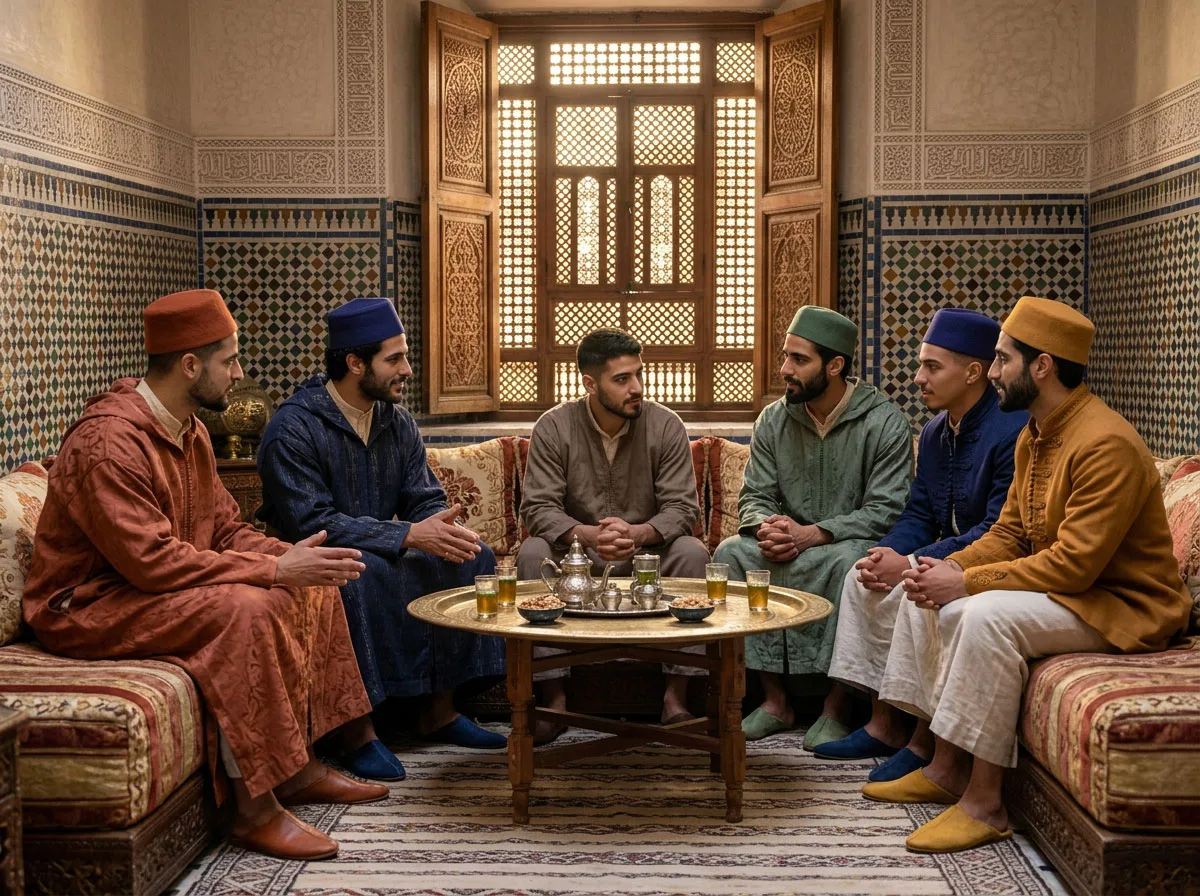
The members of the house call one another rifāq, companions, and it is the name these pages use for those who in the founding documents are the members. All the rifāq have equal rights, and each has one vote in the majlis, the body that deliberates, whatever his function in the work, his seniority or his financial contribution.
Operational functions pertain exclusively to the organisation of the work and to technical and safety responsibility: the muʿallim who runs the workshop, the nāʾib who stands in for him, the ṣāniʿ who learns by working. None of them confers a further right in the life of the house, neither plural voting nor a power of veto. A muʿallim and a ṣāniʿ, in the majlis, count exactly the same.
Where an employment relationship exists between rifāq, the mandatory rules governing it remain in force, including the bond of subordination in the performance of the work. No statutes can renounce subordination where the law imposes it, and pretending otherwise would make the text unenforceable at the first dispute.
Six months before the vote
Admission is preceded by a paid trial period of two to four weeks, spent on the building site or in the workshop. Once the trial is passed, the applicant is admitted as a ṣāniʿ under a fixed-term apprenticeship contract, with written start and end dates. After six months he acquires the status of rafīq with full voting rights, unless the majlis resolves otherwise with reasons given.
The matters removed from the majlis
The majlis approves the accounts, elects and removes the majlis al-umanāʼ, the council of trustees that administers, decides on exclusions, approves and amends the niẓām ad-dār, the rules of the house. Removed from its deliberation are the rules on safety and hygiene at work, the prescriptions on the restoration of listed buildings and the obligations of law, which constitute the perimeter within which the majlis is sovereign.
A rafīq abstains from a resolution when it concerns his remuneration, his contract or a measure against him. Without the duty to abstain, a house in which those who work elect those who direct them becomes ungovernable at the first tension.
The provisional rules lapse by themselves
The first niẓām ad-dār is provisional and lapses by right at the first majlis in which the rifāq other than the signatories of the deed of constitution form the majority; there it is readopted, amended or replaced. The automatic lapse prevents the text written by the founders, when the majlis consisted of them alone, from weighing for years more than those who come after.
Those who fund do not govern
The resolutions of the majlis are not subject to approval, confirmation, veto or reform by the founders, the funders, the supporters or any outside party. To none of them are reserved powers of appointment or designation in the bodies, additional voting rights, special categories of members or the power to suspend the effect of resolutions, and the contribution of means cannot be made conditional on the granting of any of these powers.
The three founders will be reserved a personal, lifelong and non-transferable right of lodging in three apartments on the first floor of the north wing, to be constituted by notarial deed at the same time as the purchase: a right in rem is constituted by the owner, and the property has not yet been acquired. Whoever lives in the house by virtue of that right observes the common rules like every other resident: if he is a rafīq he has one vote like every other rafīq, if he is not he does not take part in the deliberations. A right of habitation in rem is enforceable against third parties and survives the vicissitudes of the association, whereas a statutory clause could be reopened by a future majlis; non-transferability prevents someone who has never applied for admission from living in the house thirty years from now.
These provisions too can be amended only with the favourable vote of all the rifāq.
Nizam ad-dar, the rules·The names of the house·The safeguards