COMMON LIFE
Dress and outfit
The house supplies the clothing, and in the house one dresses from it. There is no uniform: there is a wardrobe of traditional garments, and within it each combines them as he prefers.
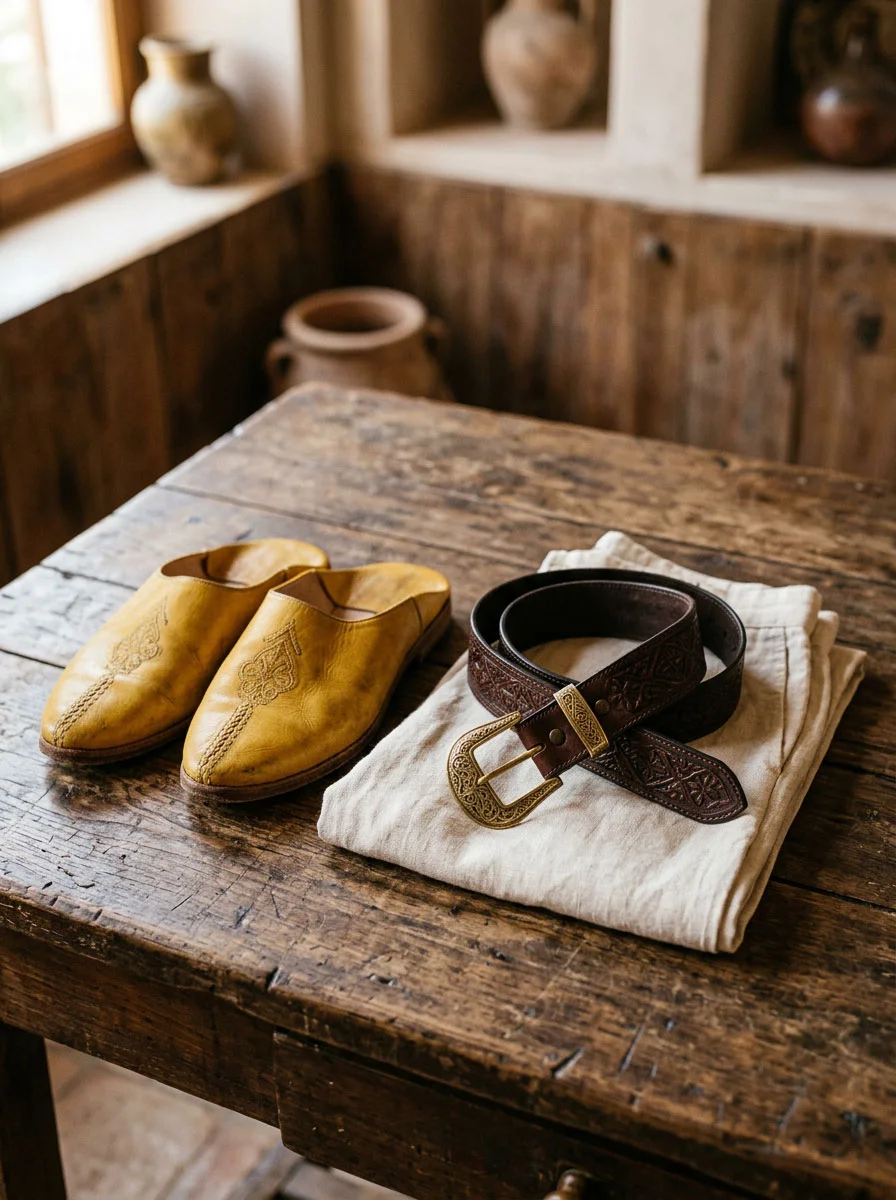
The slippers, the belt and the folded linen. Studio rendering.
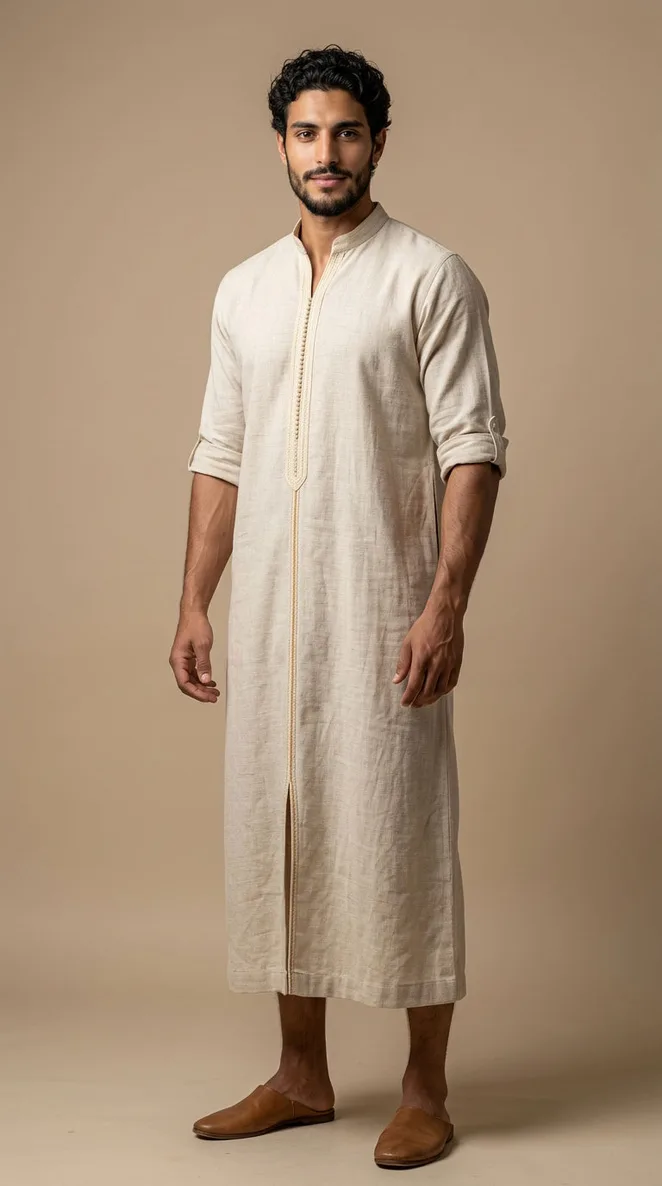
The clothing is of undyed raw linen, with the rust of the cap and the slippers, and the house gives it to everyone. Equality lies there, in the fact that nobody dresses in what he brought from home, and not in an identical uniform: one wears the qamis and another the serwal with the jabador, and the choice between the two says nothing about who makes it. The only visible difference is that between a rafīq and a ma’allim, and it is a difference of craft.
What is wanted is that each feels dressed by the Funduq: the son of well-off parents and the one who arrived without a penny dress from the same wardrobe, and neither carries on him where he comes from. It is also the simplest way of respecting the article of the statutes that forbids outward distinctions of treatment among the rifāq on account of the economic or family circumstances they come from — without asking anyone to buy anything, which is the condition for that prohibition to be real and not a formula.
The two forms
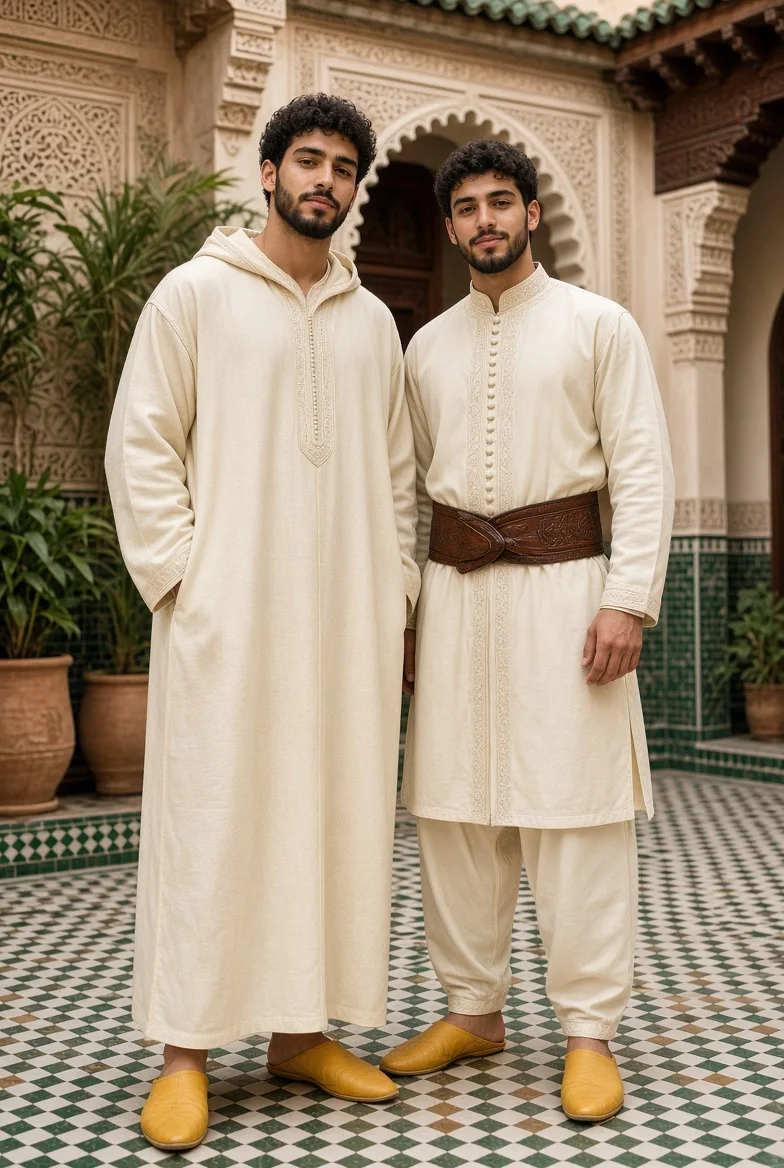
The two forms, side by side. Studio rendering.
- — The long form. The qamis to the knee, or the gandoura reaching the ankle, with the belt at the waist. It is the dress of common life: the table, the evening, reading.
- — The short form. The serwal with the jabador, the short jacket fastened with frogging that is worn over it. It sits better at the bench, because it has no skirts to tuck up.
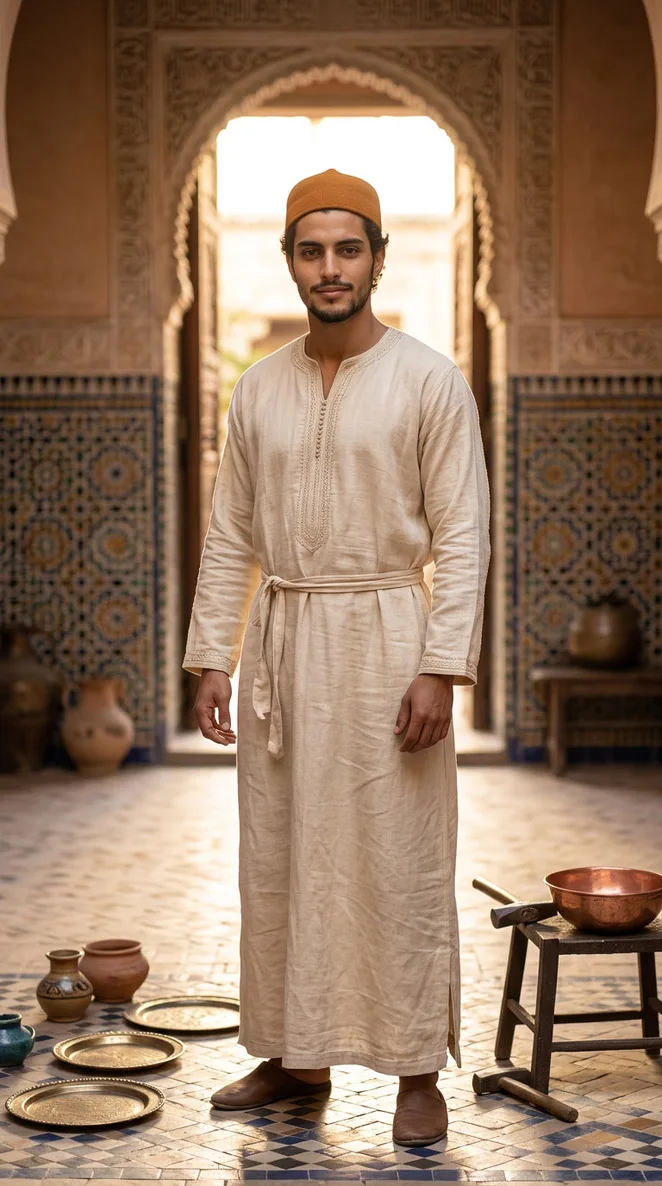
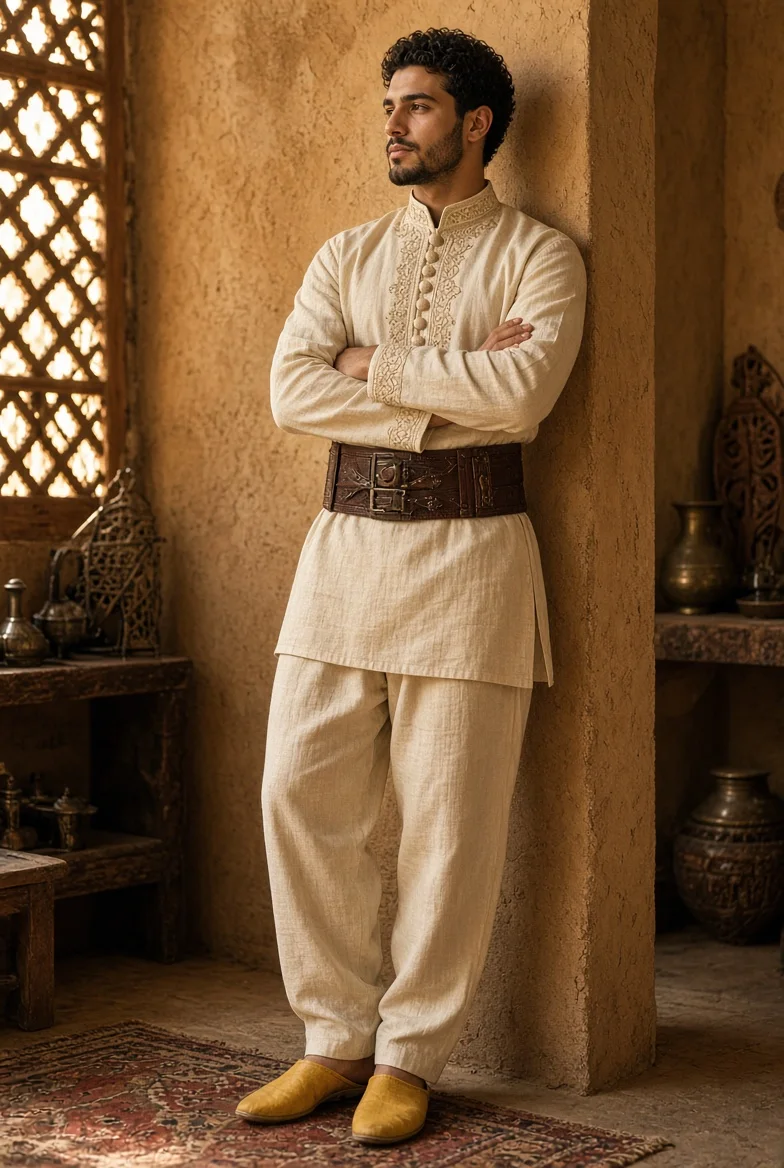
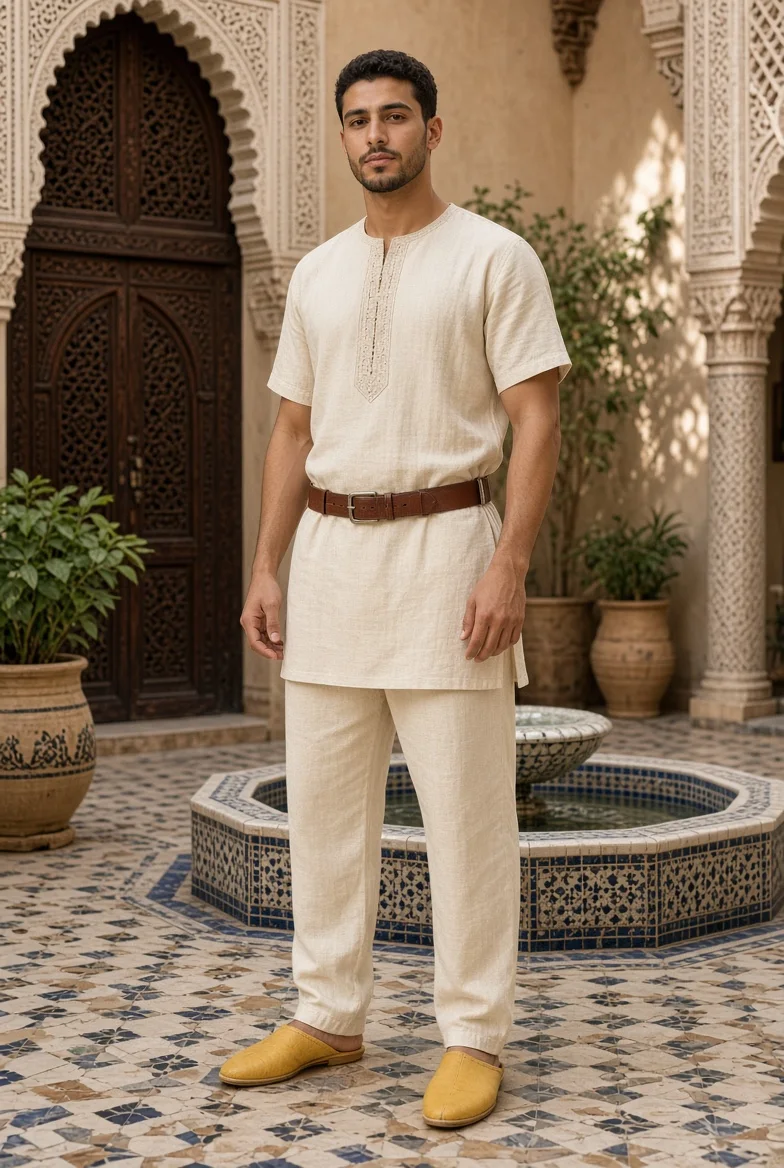
The long form; the jabador over the serwal; and the same short form in summer, with short sleeves.
These are the most common combinations and not a prescription: the rule is that in the house one wears traditional dress, from among those the house supplies, and the rest is decided by whoever wears it. One changes from one day to the next, and nobody keeps count of what people put on.
The garments
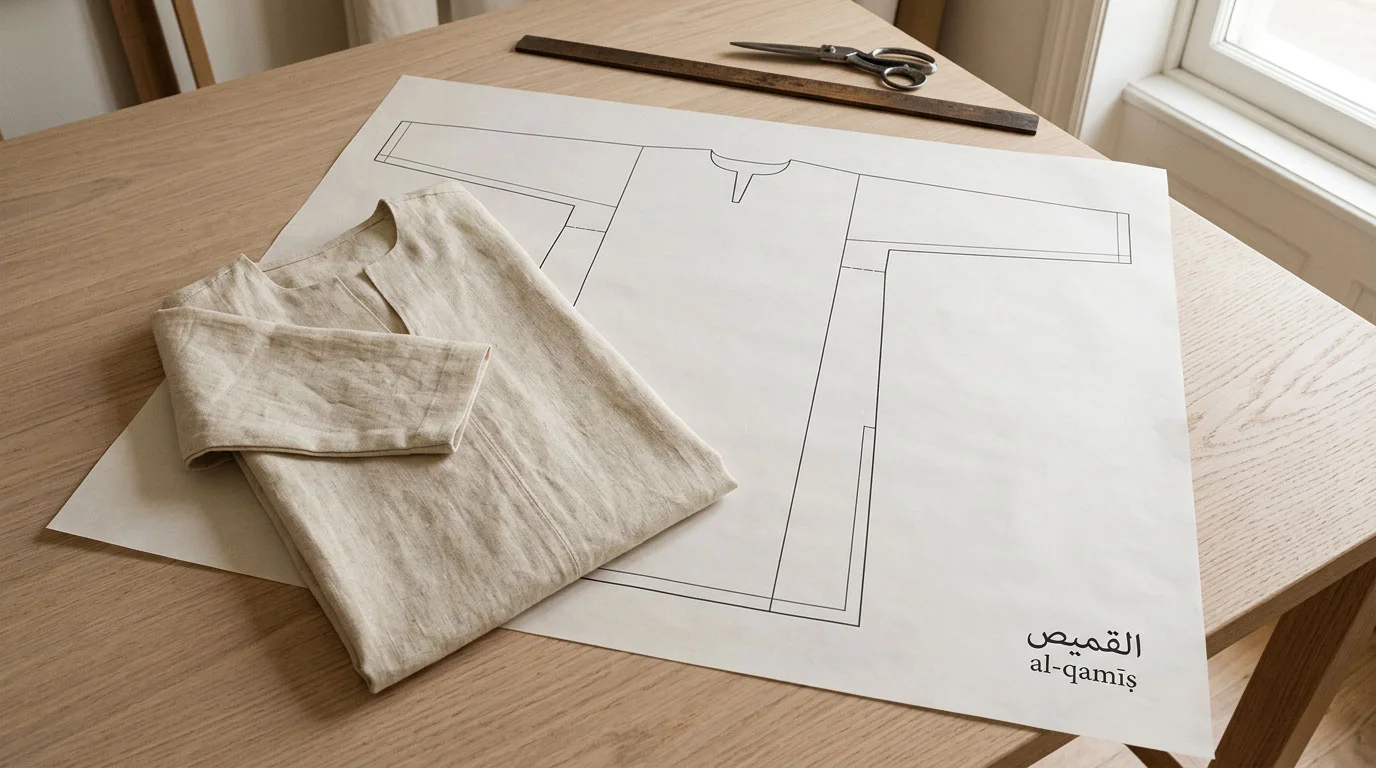
Al-qamis (القميص)
The knee-length tunic, in undyed raw linen, with sleeves that are rolled up for work. It is the garment one sees, and it is the same for the ma’allim and for the last admitted.
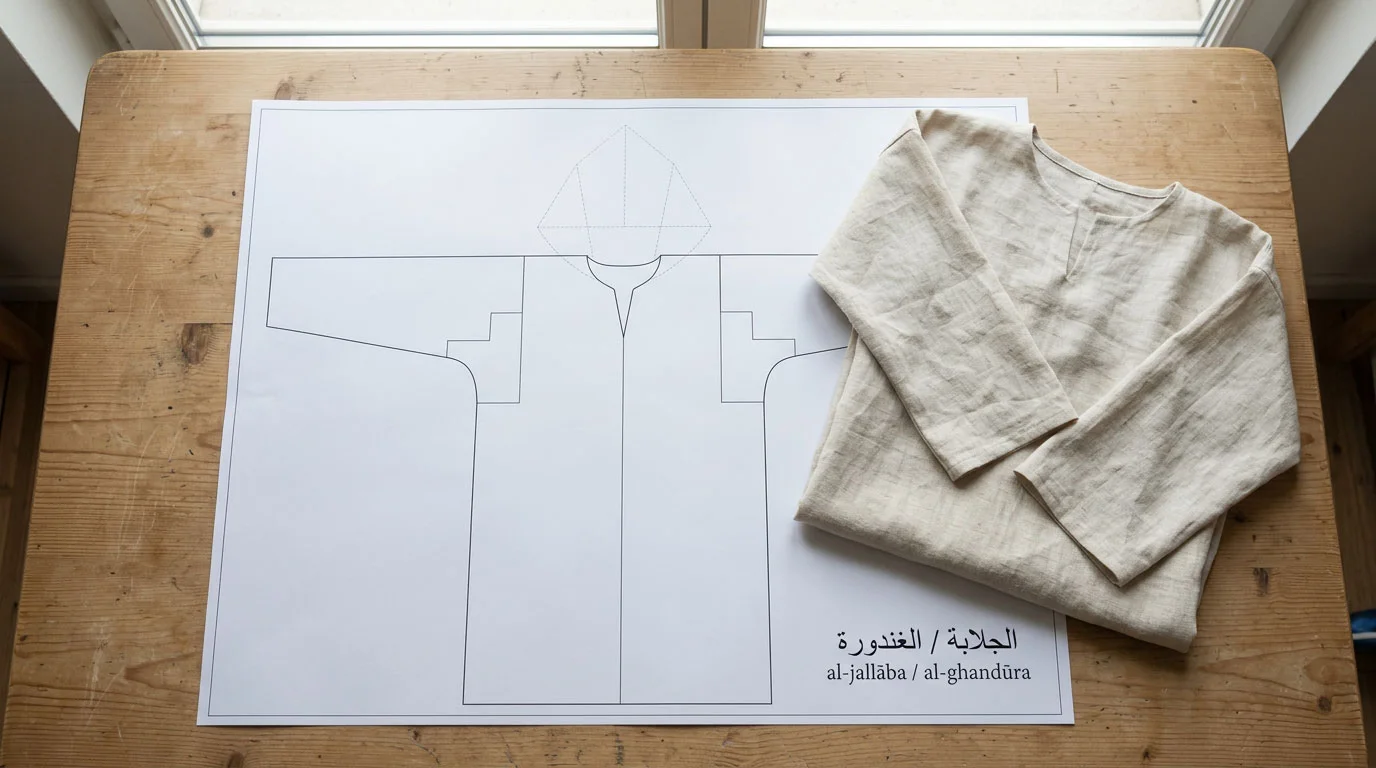
Al-ghandura (الغندورة)
The ankle-length robe, an alternative to the qamis for the long form. Same linen and same pattern, cut fuller.
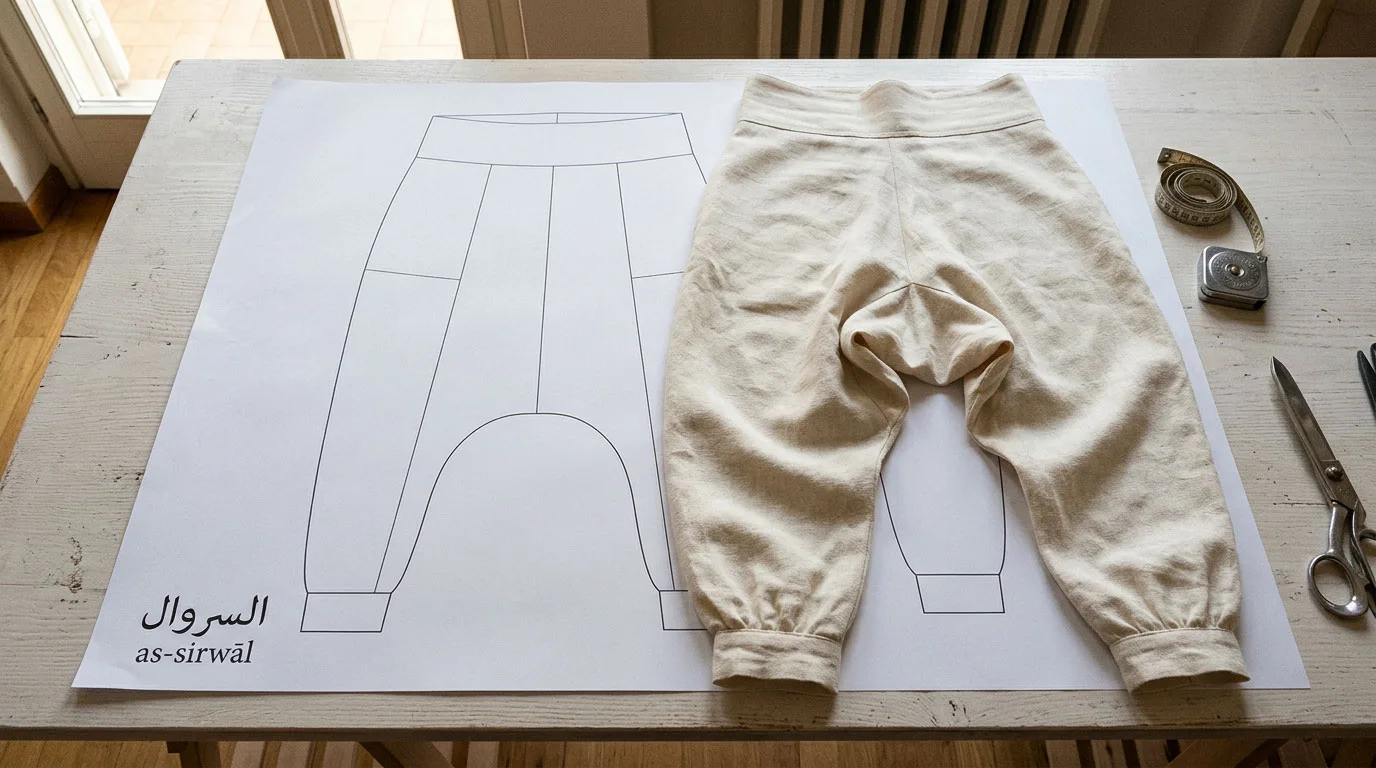
As-sirwal (السروال)
The wide trousers, gathered at the ankle by a cord. The same linen as the tunic, cut on the same pattern for all the sizes of the house.
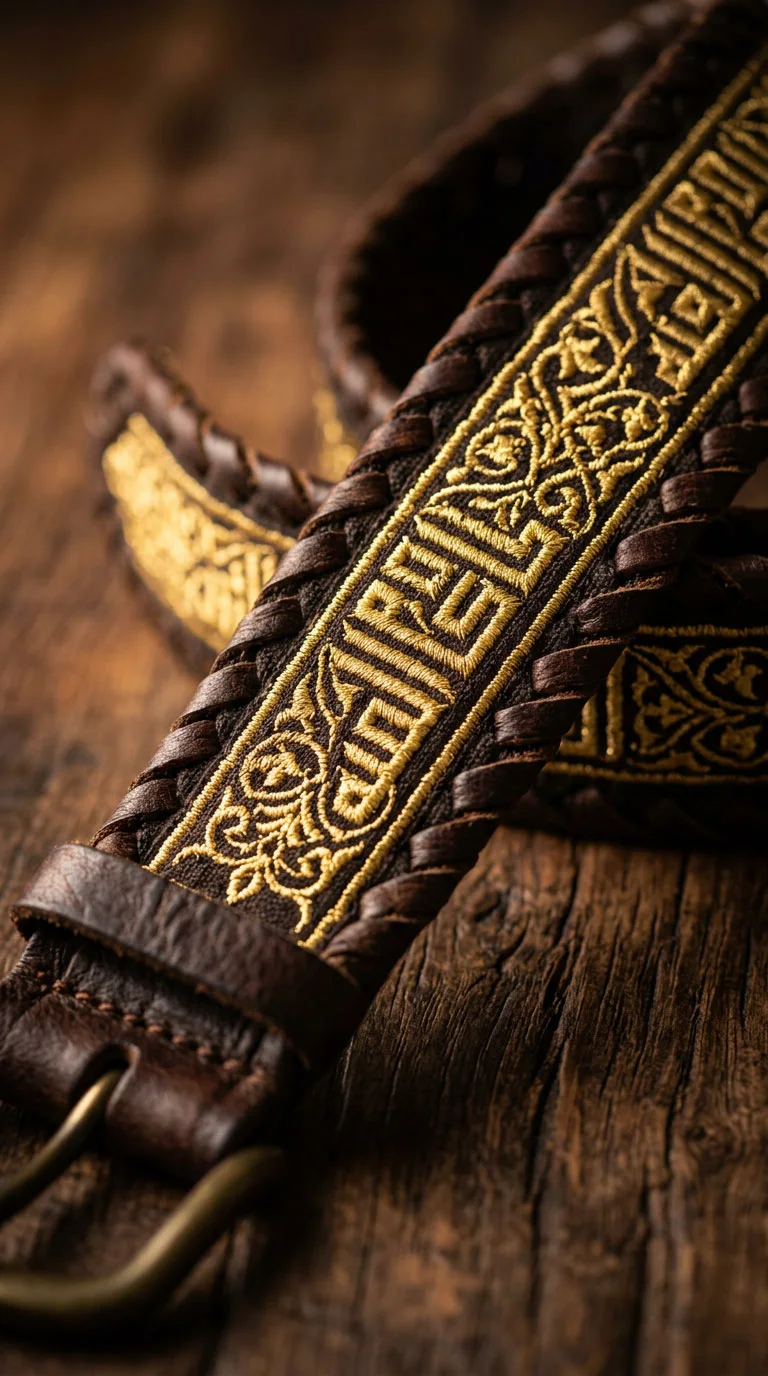
Al-hizam (الحزام)
The leather belt, made in the saddlery. It is the first finished piece of work an apprentice wears, and it is recognisable because no two are alike. That of the ma’allim is of dark leather, tooled in gold leaf.
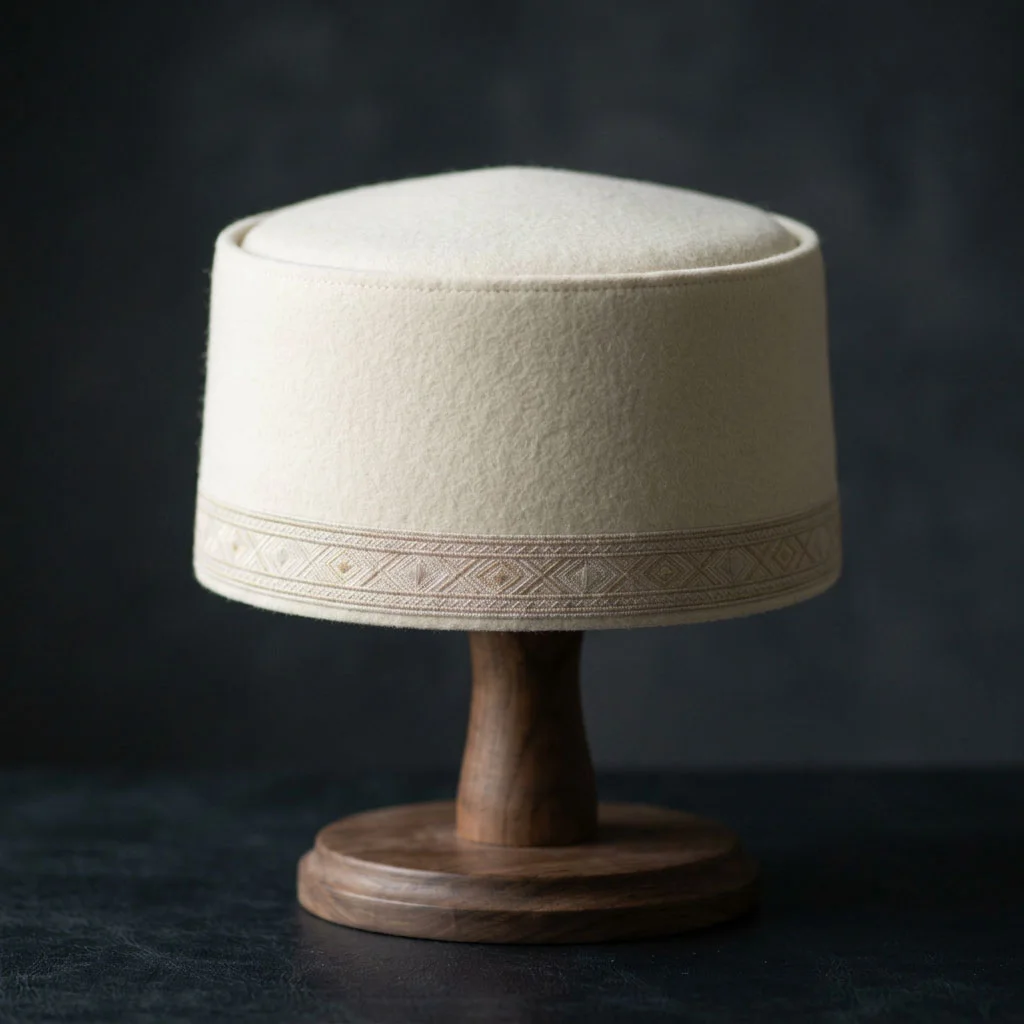
At-taqiyya (الطاقية)
The felt cap, worn in the workshop and taken off at table. It is one of the two pieces dyed rust, and it is the same for everyone.
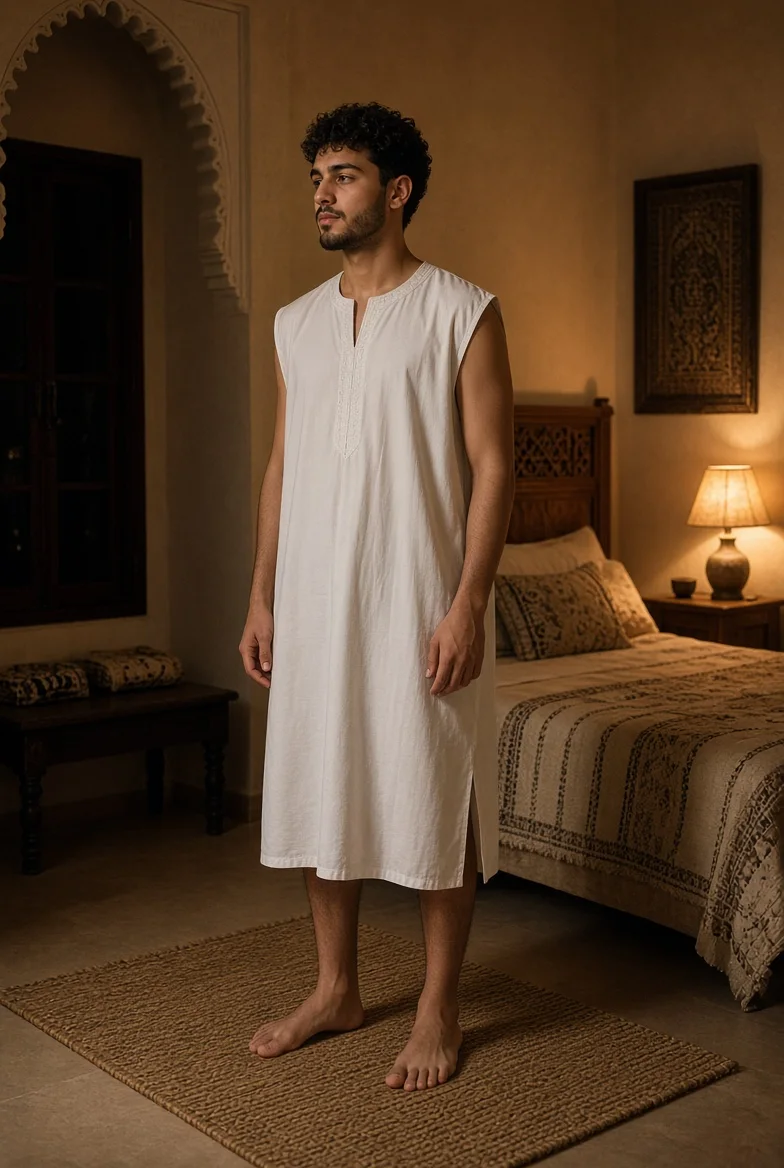
Night garment (ثوب النوم)
Shorter and lighter, for the rooms. It is part of the outfit like everything else, and like everything else it goes through the wardrobe for the wash.
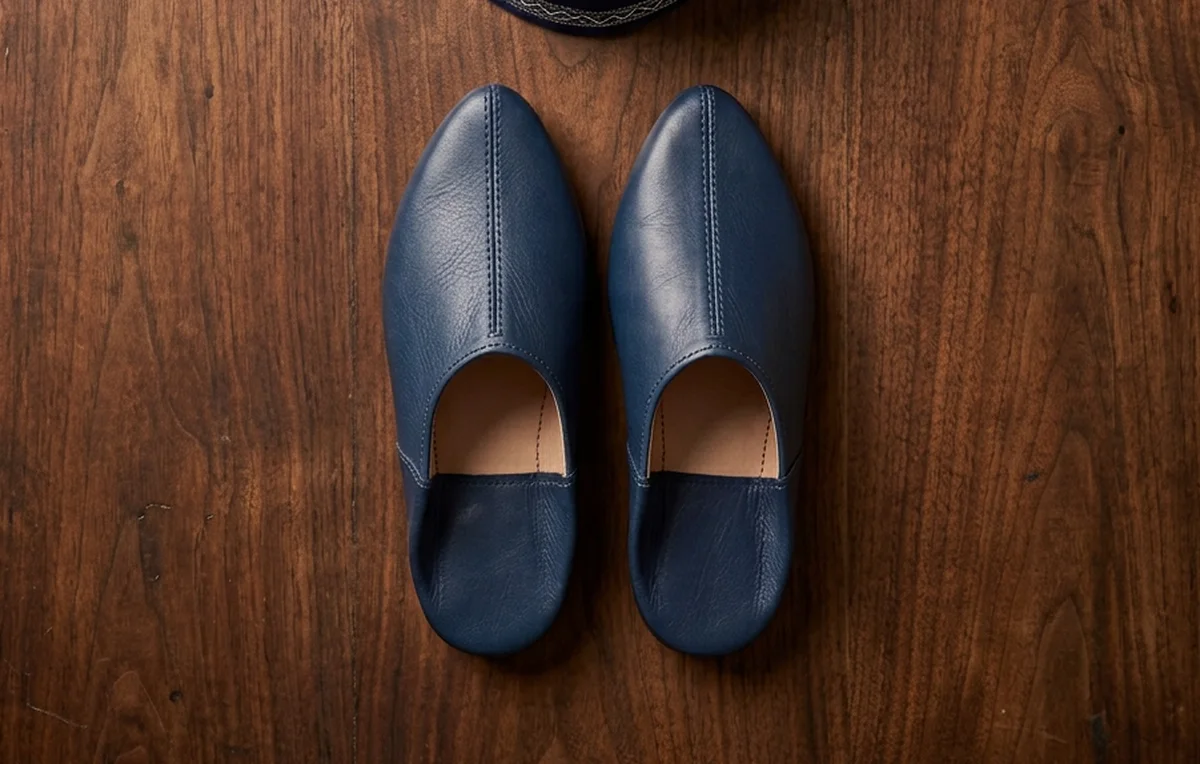
The slippers (البلغة)
In rust-dyed leather. They are worn in the house and left at the workshop door, where one changes into work footwear. The saddlery makes them, from the offcuts of saddle leather: it is the operation on which an apprentice learns to stitch before touching a harness.
What is not worn
In the house traditional dress is the norm and not the exception: the serwal takes the place of jeans and the qamis the place of the T-shirt. Nobody goes about in jeans and nobody in a jacket, and not as a matter of decorum but because they would be the only thing in the house that says something about who wears it.
Sobriety extends to the detail: no tight cuts, no branded trainers, no baseball caps, no printed or torn garments. Outside the house — in the village, travelling, in the days spent with family — each dresses as he sees fit, and the house has nothing to say.
Over the linen
The leather or canvas apron and the protective equipment the craft requires — gloves, goggles, a screen for the forge — go over the dress and not in its place. That is why the linen is cut wide: it must be able to sit under a heavy apron for eight hours without hampering the arms.
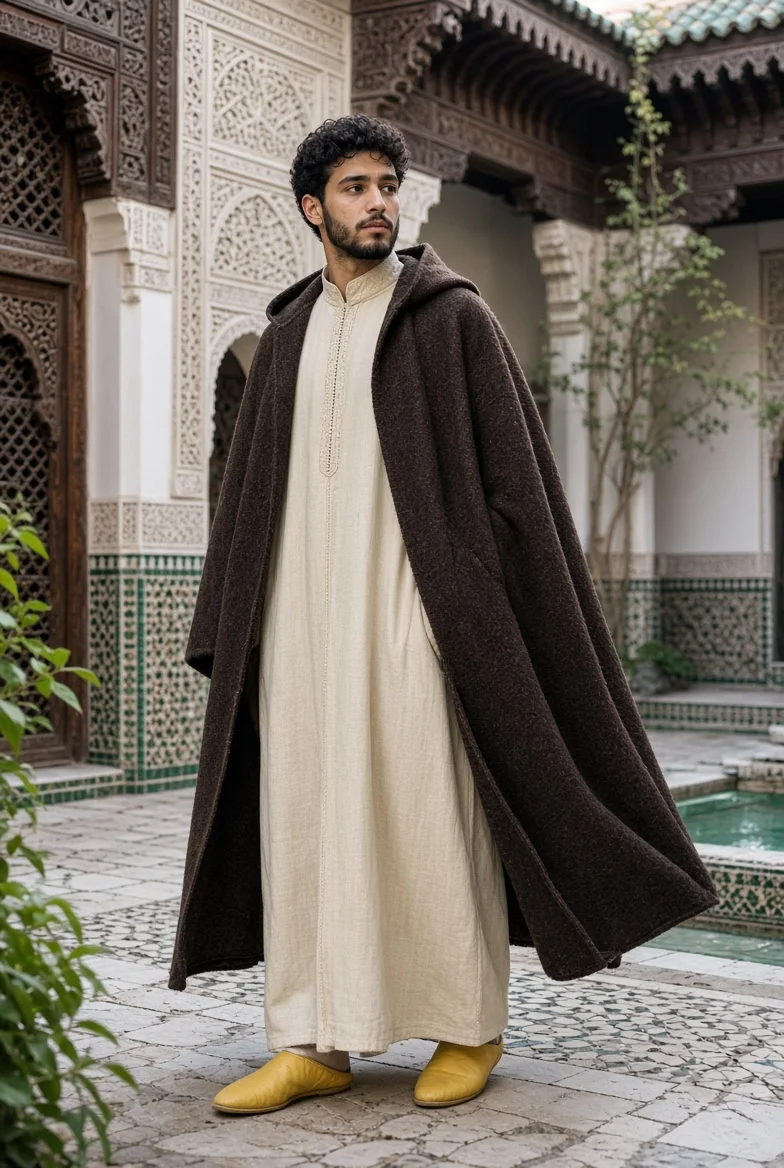
The winter cloak, in undyed wool.
In winter the hooded woollen cloak is added, in the natural brown of undyed wool: it is a large surface, and in rust it would become a costume instead of serving as a frame. Footwear is work footwear in the workshop and slippers in the house, and the workshop door is where they are changed.
Who makes it
The leather the house makes. The belts and the slippers come out of the saddlery, and not as an exercise: they are two simple, repeated and verifiable operations, and it is on those that an apprentice learns saddle stitching before a harness is put in his hands. At the other end of the same workshop stands the belt of the ma’allim, with hot gold tooling: the same operation taken to where only someone who has finished learning it arrives. An outfit for thirty people to be supplied and repaired is an internal commission that never ends, and it is exactly the kind of work one learns on.
The rest — the linen cut and sewn, the felt of the caps, the wool of the cloaks — is ordered from Fez, from the craftsmen of the medina. The reason is not local colour: in Fez those trades are still practised every day, with the right patterns and measurements, and buying from them is the way this house carries some weight in the economy of that one. It is the same relationship the house in Fez has with the workshops around it, seen from the other side of the sea.
If one day weaving and brocade open here too, part of those commissions will come back into the house. It is not intended that all of it should: a house that makes for itself everything it wears stops having reasons to talk to anyone.
One colour, and the same for all
In the house in Fez the colour of the cap and the belt says which workshop the wearer belongs to, and how far along his path he is: it is an old system, and it holds because there the workshops are six and the ranks are a guild custom older than the house that uses them.
Here the colour of the craft is on the workshop signs, which are the same series as in Fez, but it is not worn, and for a practical reason: at the opening there is one workshop only, and distinguishing a thing from itself by colours is an ornament. When the workshops are more than one, each will take its own colour, visible also in the accessories of those who work in it; it will be a resolution of the majlis and not an inheritance.
One colour there is, however, and it is the same for all: the rust of the cap and the slippers. It is the colour of the place — the Iblean earth is red, the roof tiles are terracotta, and the stone of Ragusa turns from cream to rust where it weathers — and it is also the colour leather takes with vegetable tanning, which makes it a plausible product of the saddlery and not a choice from a swatch book. It sits at the head and the feet, which are the two places where a colour reads as deliberate rather than as a garment.
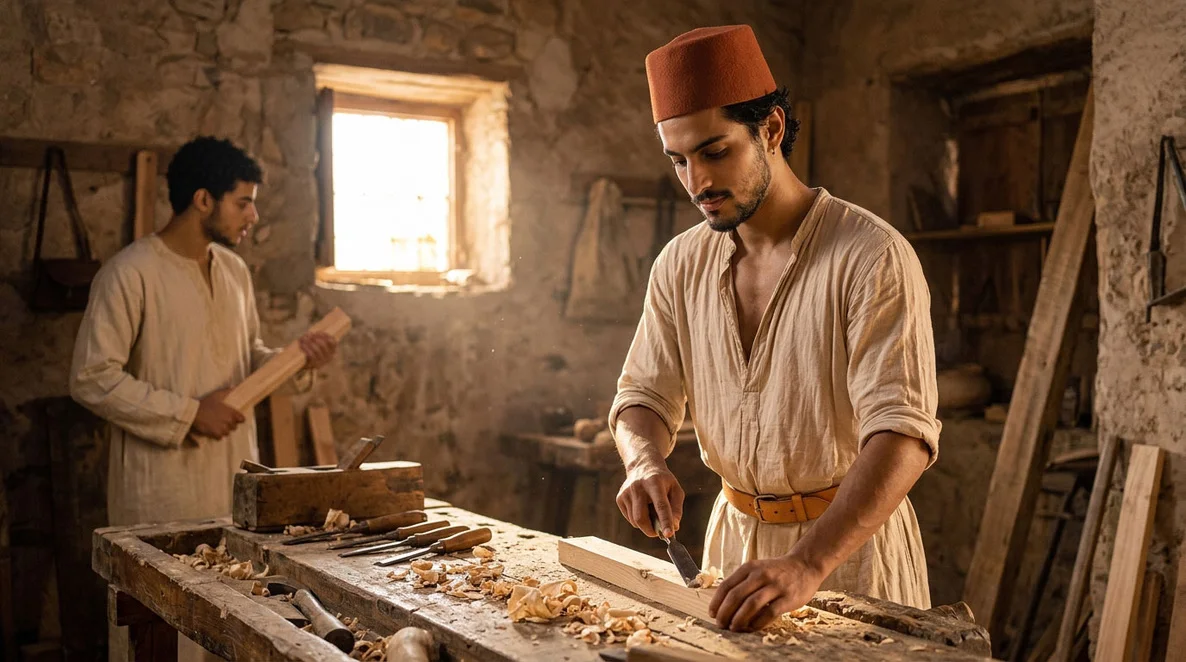
Rust at the bench. Studio rendering.
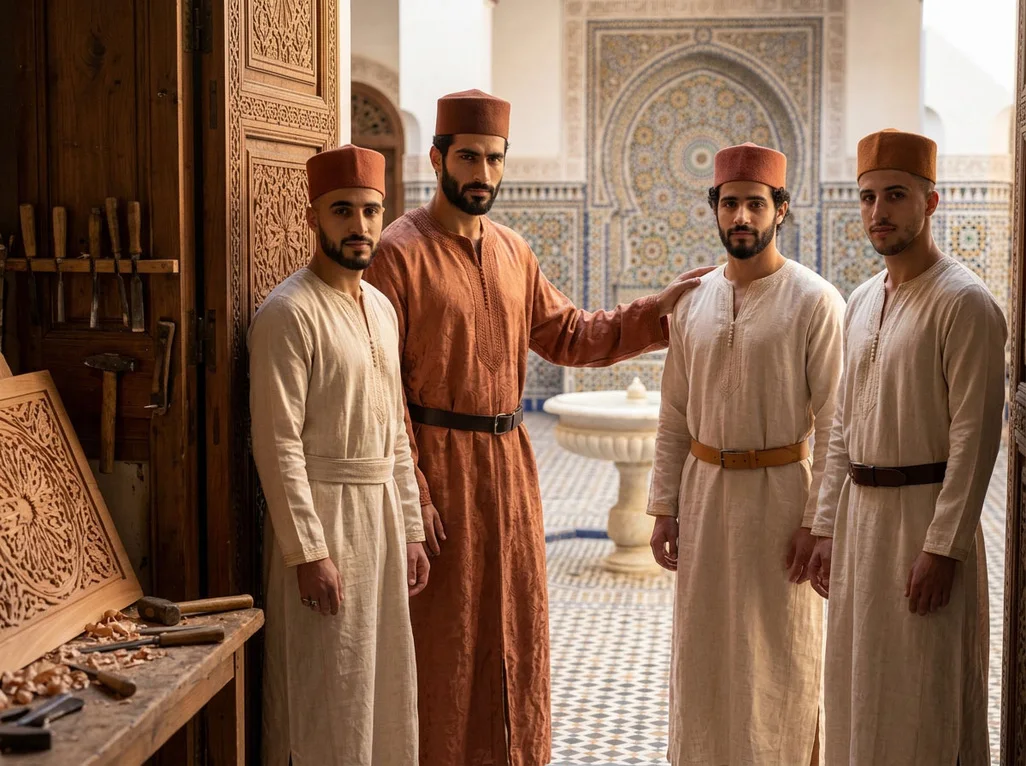
The ma’allim and three rifāq. Studio rendering.
The ma’allim wears the same rust to a greater extent: the whole garment, and not the cap alone. It is the same dye, worn more extensively: not a colour reserved to him, and not a separate palette. The statutes forbid distinctions of treatment on account of economic or family circumstances: hours, table, lodging and common services are the same for everyone, and no privilege belongs to the ma’allim by reason of his function. Rust says what someone has become, not where he comes from nor what he has; whoever wears it eats at the same table, sleeps in an identical room and does the same shifts.
With the garment goes the belt, and it is the most fitting part of the mark. That of a rafīq is his first finished piece of work; that of the ma’allim is of dark leather with hot tooling in gold leaf, which is among the highest operations of the saddlery. The house’s workshop makes it, or it is ordered from Fez until the house knows how to make it: the mark of the master is itself a master’s piece, and not a badge that was bought.
The fabric then says the occasion. At the bench the ma’allim’s garment is of the same raw linen as everyone else’s, because the master works: a damask among awls, wax and glues lasts a week, and whoever wears it either does not work or ruins it. At table, in the majlis and on the occasions when the house shows itself, the garment is of damask in the same rust, and with it goes the belt with the gold — which thus does not spend its days against the stitching clamp.
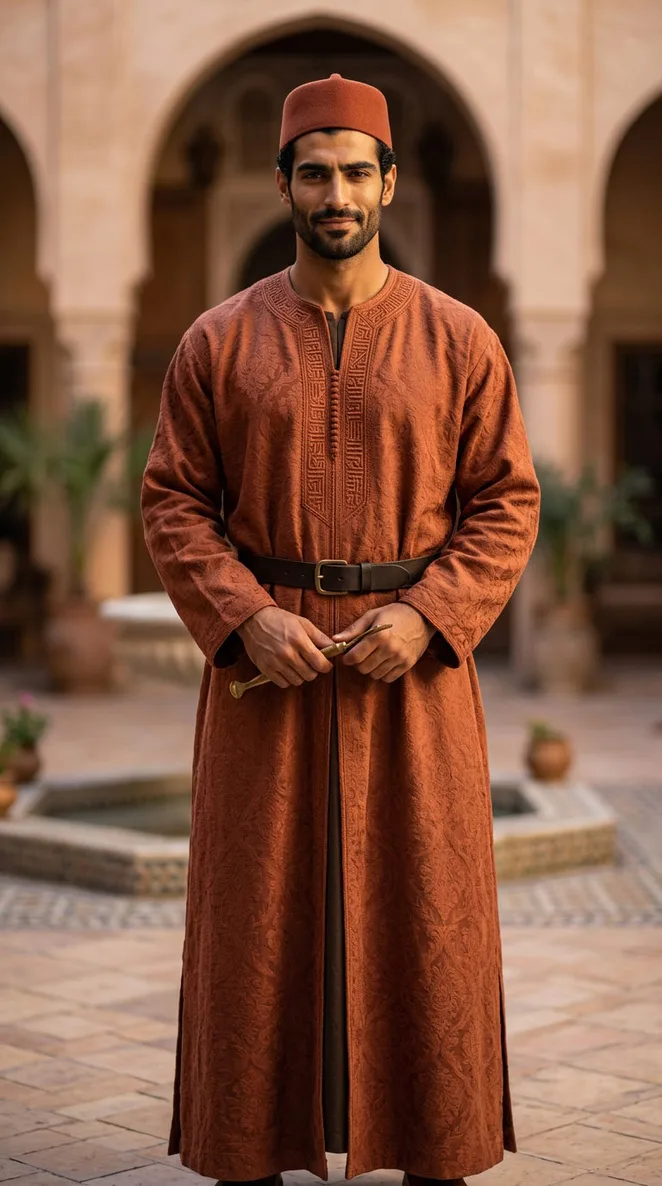
The rust damask and the raw linen, the same cut. Studio renderings.
The damask is monochrome: the pattern shows in the reflection of the light and not in a second colour, and it is the most sober way there is of marking a difference, because it changes the material and not the dye. It is of linen like everything else and not of silk: silk would say wealth, which is exactly the distinction the statutes forbid, whereas a linen damask is the same thing as the others woven better — which is exactly what a master is.
Weaving and brocade is the fifth discipline of the house. Until it opens the damask is ordered from Fez; when it opens, the master wears a fabric that came out of the workshop next to his, as he already wears a belt that came out of the saddlery.
Between these two there is nothing else. No intermediate rank, no colour for years of seniority, no mark for someone halfway: one is rafīq or one is ma’allim.
The dye baths are natural, and the batches vary: two caps ordered two years apart will not be exactly the same rust. It is not a defect to be corrected and it is not corrected, because correcting it would mean going over to industrial dyeing. What holds for the belt holds here too, each stitches his own and no two are alike: the equality of the house lies in what is worn, not in the matching of samples.
The cloak stays outside all this: in Fez there is one per guild, and lined up they make a row of six colours. Here there is one only, in the brown of undyed wool.
The circuit, and who keeps the garments
As long as one stays in the house the garments circulate: one leaves the workshop, passes through the changing rooms, leaves the dirty garment at the wardrobe, takes up the clean one. Nobody washes in his room, and nobody arrives at table wearing the day. What goes back to the wardrobe every evening is the laundry, and the house washes, mends and replaces what wears out.
But the garments belong to whoever wears them, and whoever leaves takes them with him. It is the condition for the sentence this page starts from to be true: one feels dressed by the Funduq if that garment is one’s own, not if it was lent and is taken back at the door. And it holds all the more for the belt, which he stitched himself in the saddlery and which nobody could ask him to give back.
The wardrobe is sized on this: two sets each in rotation, plus spare sizes, so that whoever arrives finds his size on the first day and not after a month. It is a recurring item of expenditure that the budget carries as such, and not a detail of style.