THE NETWORK
The network of houses
Since the unit is a set of statutes and not a territory, the natural form of this thing on a larger scale is a number of small houses rather than a single large settlement.
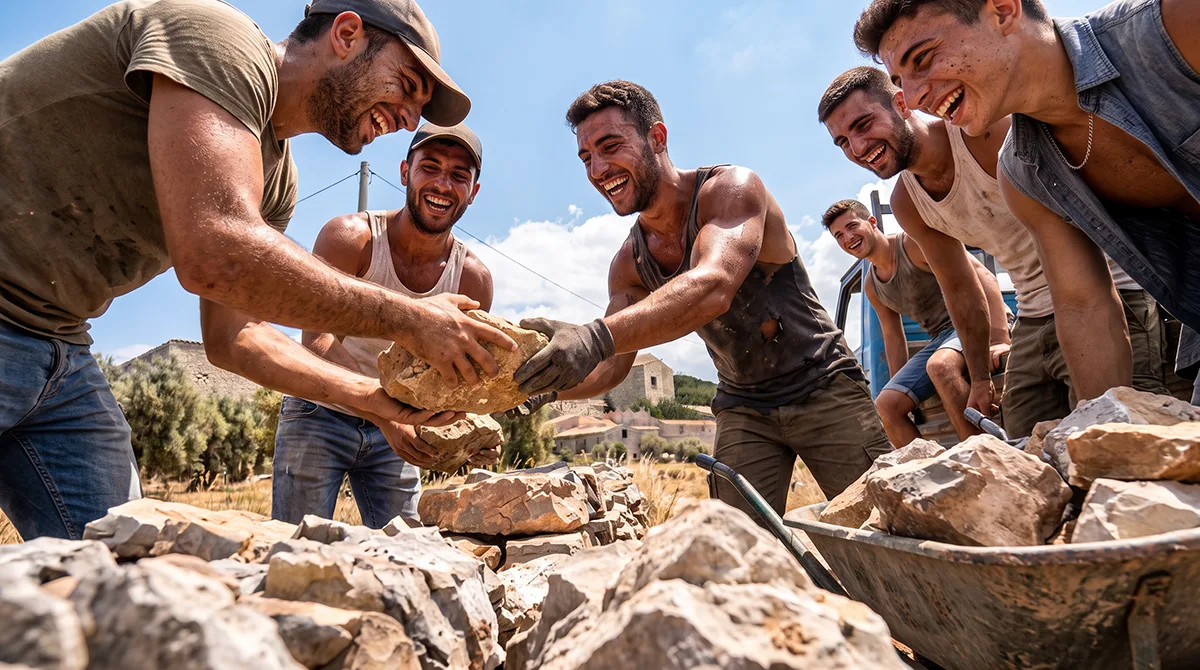
Each house stays at a size that can actually be governed, and scale comes from the number of instances. In Italy and elsewhere in Europe there is no shortage of depopulated centres with usable building stock, which lowers considerably the cost of each new house. We would not build on public incentives for repopulation, however, because a network that depended on them would no longer be independent of government; the availability of the stock remains a fact all the same.
What makes a first house interesting is the statutes it puts to the test, more than the building it restores. If the statutes hold, they can be founded again within a year in another town, by people other than those who wrote them the first time.
Trade holds together, but is not enough
Between existing houses an internal market opens: a piece begun in one and finished in another, materials and techniques that move, apprentices and masters who go where the work is. Trade gives the houses a reason to stay together, but it does not answer the question that matters, namely who establishes that a house has ceased to be one. If a house admits by category, suppresses the right of withdrawal or treats its apprentices badly, trade does not correct it: good work sells anyway, whatever the government of the workshop.
A single sanction
The lightest structure that answers that question is a federation under common statutes, with a single central power: the withdrawal of recognition. A house that loses recognition loses the name and access to the internal market, and nothing else. No property, no appointments, no authority over the internal life of any house.
Whether a federation of this kind is stable over twenty years, or whether such arrangements drift towards common ownership as they grow, remains an open question. It is one of the questions we deliberately keep open, and on which an informed judgement would be of value.
What the two projects already written prove, and what they do not
The same statutes have been written twice, in two legal systems and two religious traditions: here in Sicily, and for a house of the crafts in the medina of Fez. The exercise showed that almost nothing of what matters lay in the building. The rules of admission, the discipline of work, the separation between ownership and management and the settlement of disputes among members passed intact from Italian cooperative law to a Moroccan medina; what did not pass was the real estate.
It is a proof of transferability, and it is not a proof that the model works, because neither house is yet inhabited. The Sicilian project would be the first occasion on which this is put to the test, and that is exactly why it is worth funding and why the conditions of its failure are published in advance.
What would count as a verdict·The twin project in Fez·Where the master goes