COMMON LIFE
The common spaces
The Funduq is a house of common life for healthy, independent young adults. In law it resembles a religious order or a private school, in the precise sense that its discipline holds because its members accepted it on joining, and that is the argument on which the legal framework rests. In daily life there is nothing monastic about it: no vows, no enclosure, no renunciation of one’s own property, no spiritual authority, and a withdrawal exercised by letter. The spaces are made accordingly.

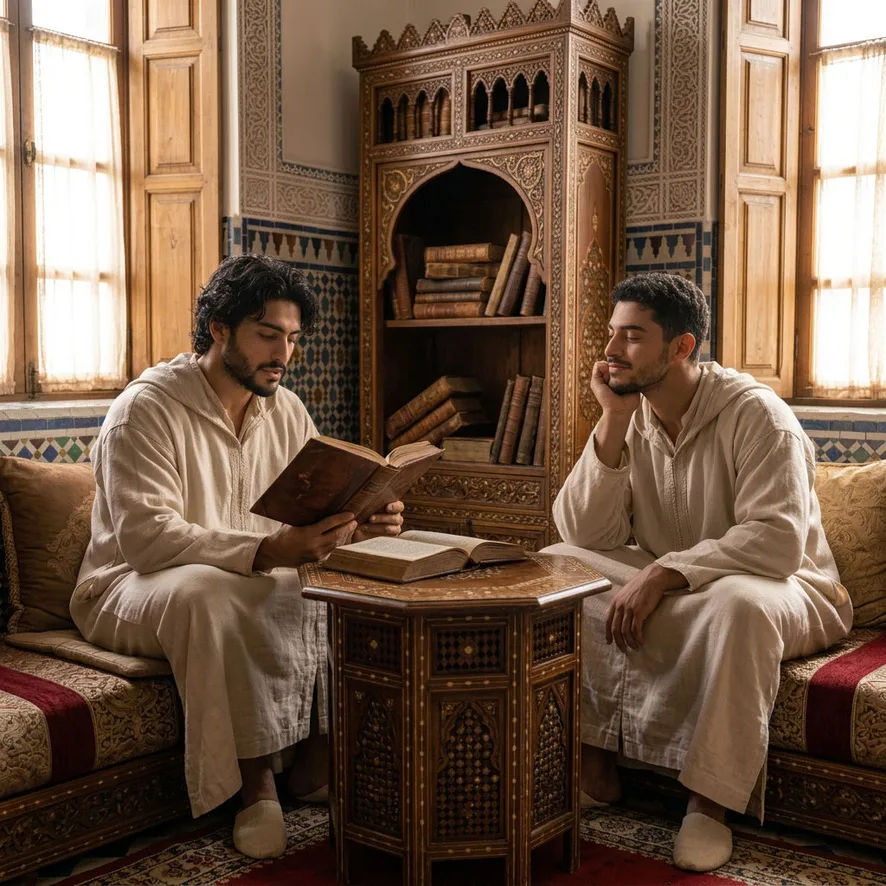
The house asks much of those who live in it: workshop hours, service shifts, farm work, the niẓām ad-dār, the rules the rifāq have given themselves and review every year. A community that asks this, and asks it of young men who could be elsewhere, must be a place one gladly comes back to in the evening. Austerity as an entrance filter selects for the willingness to endure rather than for aptitude in the craft, and it is a mistake paid for at the second intake.

The rooms
Traditional wooden beds, of Arab-Andalusian make, with fine furnishings: wardrobes and chests from the joinery, not mass-produced furniture. Rugs on the floor and terracotta or timber floors, which are not only a matter of taste, because in a building of heavy wall inertia wood and wool are what makes a room warm to the touch while it stays cool in air.
Winter heating is by low-temperature coils embedded in the plaster of the walls and the screed of the floors, fed by the thermal storage — solar, combustion chamber of the hammam, biomass boiler for top-up — according to the criterion adopted at the Riad: the mass is heated and not the air, and in the rooms where people sleep nothing burns. In summer the same room works on the passive cooling described elsewhere, with night draught from the rooflights and air from the buried duct. No visible appliance, no outdoor unit on the fronts.
The quality is the same for everyone, from the first rafīq to the last admitted, and it follows from an article of the statutes before it follows from courtesy, since hours, table, lodging and common services are the same for each, and no outward distinction of treatment is allowed on account of the economic or family circumstances one comes from. A good furnishing equal for all costs less, in terms of cohesion, than a modest furnishing that someone can improve on his own account.
How it is heated and cooled·Nizam ad-dar, the rules

The rooms
A reading room with the library of the house, where silence is kept by convention and not by obligation. A winter sitting room around the fireplace and the storage stove, which is where the evenings are spent between November and March. A summer sitting room under the loggia of the courtyard, and the terrace, which from June becomes the dining room.
Beside these, the spaces for study and shared work: long tables, good light, sockets and network, for whoever draws, keeps the accounts of a commission, studies for his own path or works on something of his own. A house of the crafts of the twenty-first century needs a place where one writes an email to a client, and pretending otherwise would produce a stage set instead of a place.
The open spaces
The courtyard is the centre of the house and its ordinary gathering space: one passes through it constantly, one sits there in the evening, the concerts and the tables of the public programme are held there. The garden to the north, under the striped shade cloth, is the cool place of the summer afternoon. The paved threshing floor in front of the entrance carries a match, a fair, a dry-stone-wall building site.
Twenty-three hectares of land around mean that none of these things has to compete with another for space, and that the sports facilities, the stables and the photovoltaic array stand where they are not seen from the main fronts.
Why this is not an accessory
Among the conditions that would count as a negative verdict on the project there is one that concerns this page directly: that more than half of the first intake of apprentices leave within eighteen months for reasons other than completing the path. The reasons a twenty-year-old leaves a place after a year are almost always the same, and they concern how one lives more than what one learns.
Comfort is therefore a condition of the working of the house, and it must be designed with the same seriousness as the draught of the flues. What the house asks of its members is severe, and it would be unsustainable in an uncomfortable place.
The body and the day·What would count as a verdict·The public programme