COMMON LIFE
The hammam
A hammam is a furnace, and rooms arranged around it. It is the fire that decides the plan, before the layout and before the surfaces, and everything else comes after.
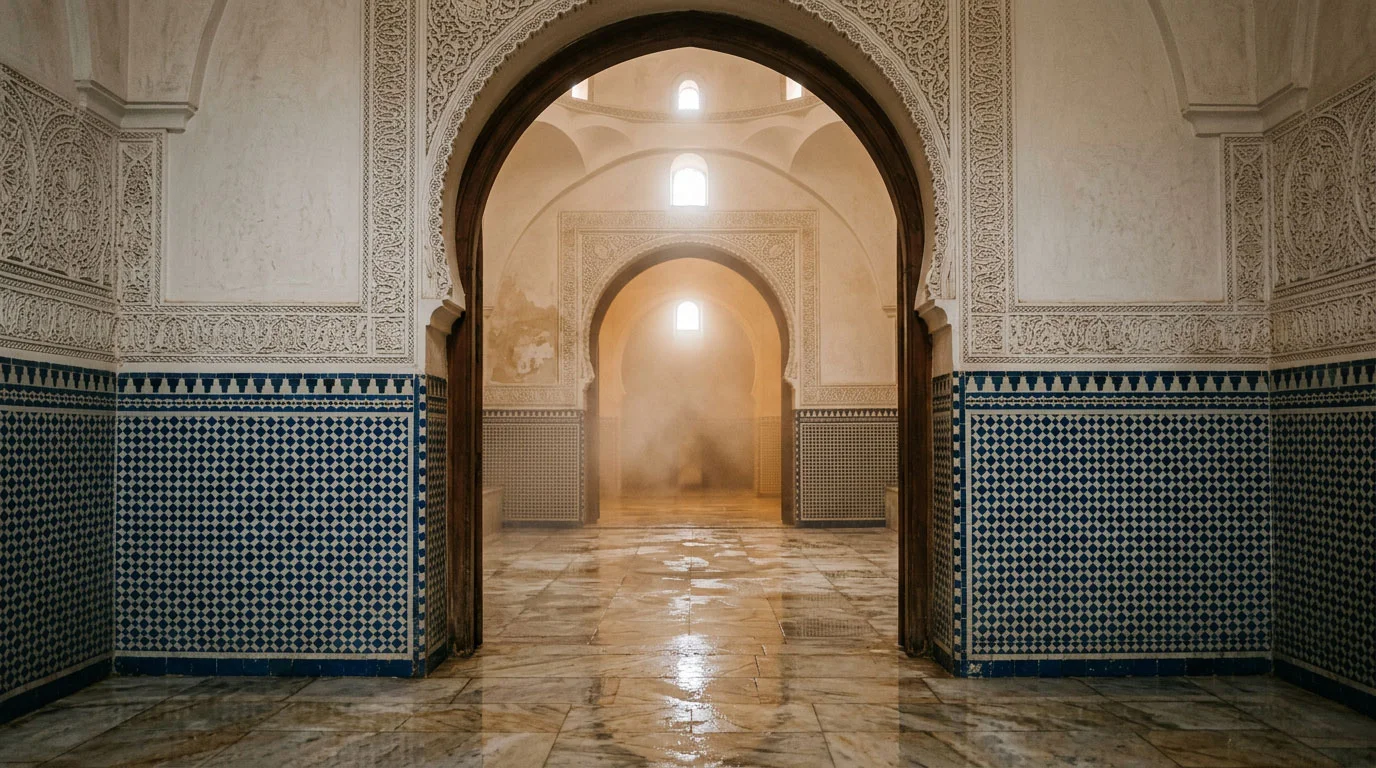
The three rooms in sequence. Studio rendering: the house does not yet exist.
The method comes from the Roman hypocaust, which the baths of al-Andalus and then of the Maghreb preserved without altering it. The fire does not stand inside the bath: it stands outside, against the wall of the innermost room, and it works twice. First it heats the water, in the copper vessel set above it and in the masonry basin built against it from which water is drawn. Then the smoke, with the heat it has left, passes under the floor through a network of channels formed between small brick piers, and heats it from below before leaving by the flue. Whoever bathes never sees the fire.
How it works
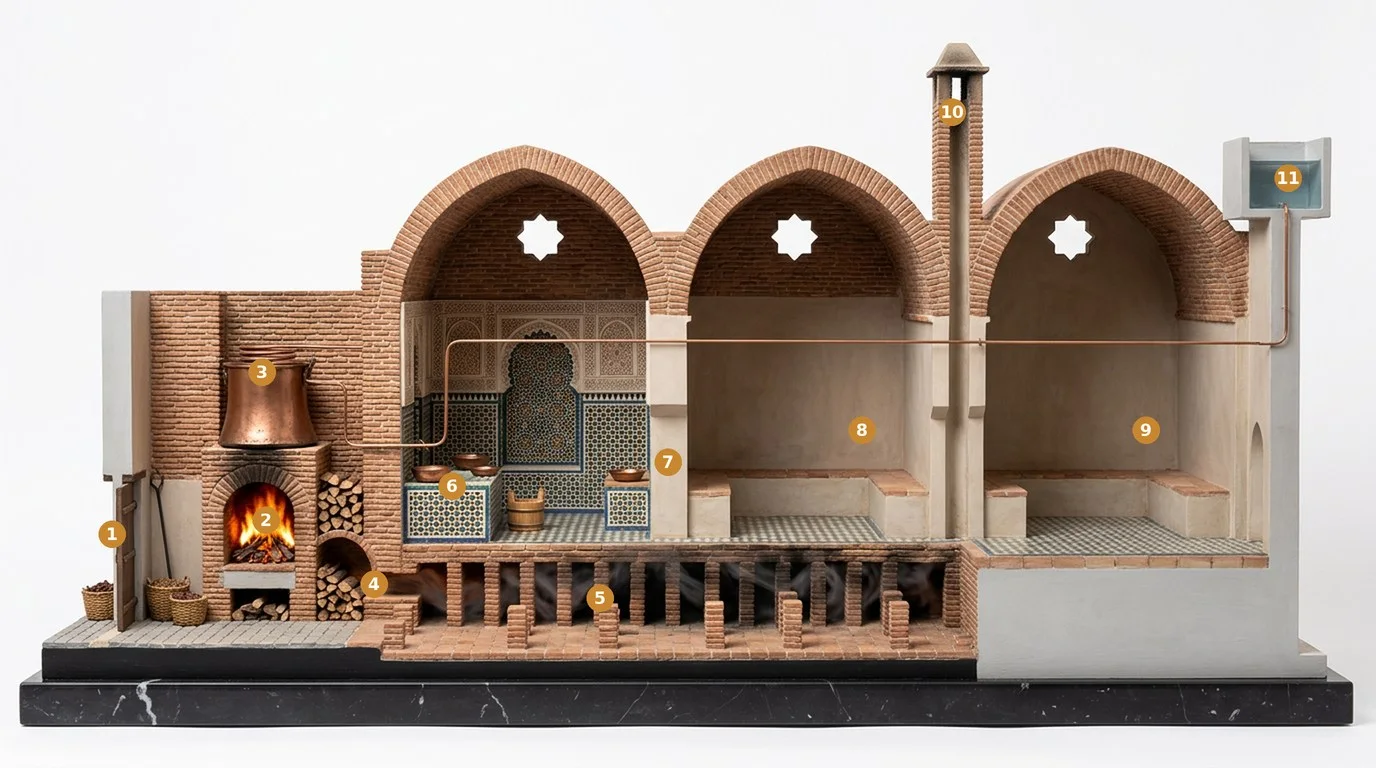
Sectional model, on a medina hammam. It is an illustration and not a design.
- 1. The service yard and the back door. The fuel comes in there and the ash goes out there: they never cross the house.
- 2. The furnace, bayt an-nār, outside the bath and built against the wall of the innermost room, with the wood beside it.
- 3. The copper vessel above the furnace: that is where the water is heated.
- 4. The mouth, the arched opening flush with the floor, through which the flame passes under the paving.
- 5. The chebka: the small brick piers. The channels are the voids between one and the next.
- 6. The borma, the basin against the furnace wall from which water is drawn, and the copper bowls.
- 7. Ad-dākhilī, the innermost room: the hottest because the nearest to the fire, and the most ornate.
- 8. Al-wasṭī, the middle room.
- 9. Al-barrānī, the first room: here the floor is no longer heated.
- 10. The flue, at the end of the run.
- 11. The cold-water tank.
The three rooms
The rooms take their names not from their temperature but from their position, and they are the names the bathers of Fez use: al-barrānī the first, al-wasṭī the middle one, ad-dākhilī the innermost. The sequence is read from outside to inside rather than from cold to hot: the hottest room is simply the innermost, because it is the one built against the furnace. One enters by the first, stays in the third, comes back.
The masters of Fez build it
The hammam of the Funduq is a new work inside existing walls: the volume is already there, and what is built are the vaults, the furnace and the ducts, which never belonged to the masseria. It is made by the same hands that make the workshops, the masters who come from Fez, where these baths have been built and repaired without interruption for centuries. The tadelakt of the surfaces, the cutting of the zellij of the dados, the carved plaster of the innermost room are the disciplines of the house applied to a building of the house.
That is why this is the only room of the masseria that will look like Fez and not like Sicily, and it will do so rightly. Elsewhere the building is Iblean and must remain Iblean; here the form is inseparable from the working, and whoever knows how to make it makes it as he learned it. It is also the first building site on which the masters work together before the apprentices arrive, and it serves to find out whether they work well together.
Small by choice
The dimensions are those of a house, not of a public bath: seventeen people at the opening and about thirty at full strength, with three sessions a week. A medina hammam serves a neighbourhood, and its plan reflects that load; here it does not, and building it at that size would mean spending on volume and on fuel for empty rooms.
The reduction does not touch the quality of the surfaces, which is where the beauty of these places lies and where the money saved on cubic metres goes. A small hammam well made is one thing; a large one badly finished is another, and the second costs more. It holds for the working too: a smaller mass comes up to temperature sooner and holds it with less fire, which counts on a system fed by offcuts and not by bought wood.
The fire, and what burns in it
The furnace of the hammam heats the bath and, through the coils embedded in the plaster and the screeds, the rooms where people sleep. It is not the only fire of the house — there are the kitchens, the fireplace of the winter sitting room, the storage stoves and the forge of the saddlery, each with its own flue — but it is the one that works most continuously and the only one attended for the whole length of the session.
What burns in it is what the house discards. The hammams of Fez have always burned the offcuts of the joiners of the medina, sawdust and the pomace of the oil mills; here the offcuts are produced by the house itself, between the prunings of the olive grove and the cuttings of the workshops. It is a loop that closes without having been drawn.
How it is used
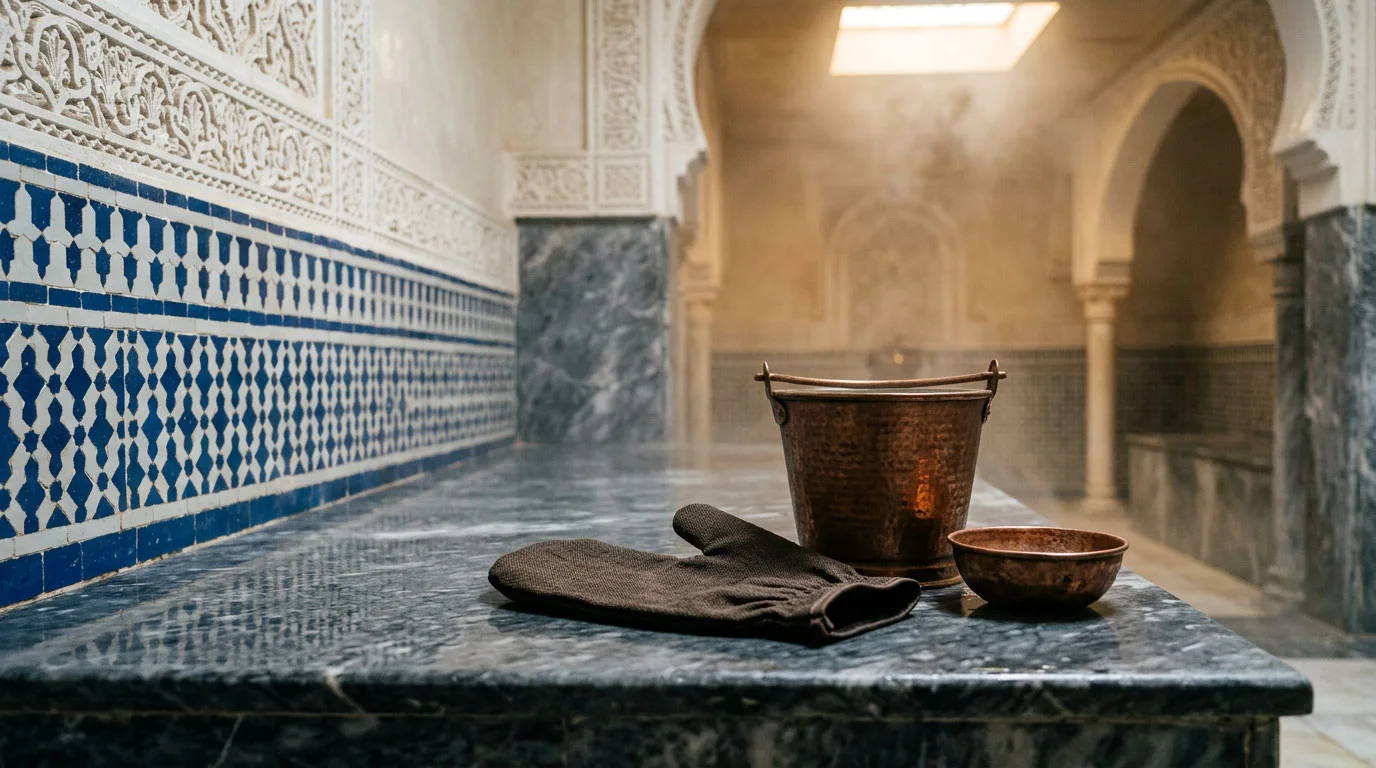
The kit: the glove, the bowl, the soap. They belong to the house and go back to the wardrobe.
The hammam stands in the same building as the changing rooms, the gymnasium, the laundry and the wardrobe, and is part of the circuit of the outfit: one leaves the workshop, passes through the changing rooms, leaves the dirty garment, takes up the clean one. It is not a courtesy service and has no spa opening hours: it has a timetable resolved by the majlis, like the shifts and the table.
Sessions take place in the presence of at least two appointed persons, never on an individual basis or by private arrangement, under the same contact rules that apply to the gymnasium and to the other activities of the body.