AL-ANDALUS
Spain, and a whole building
Sicily has the word and the texts. Spain has a building one can walk into.
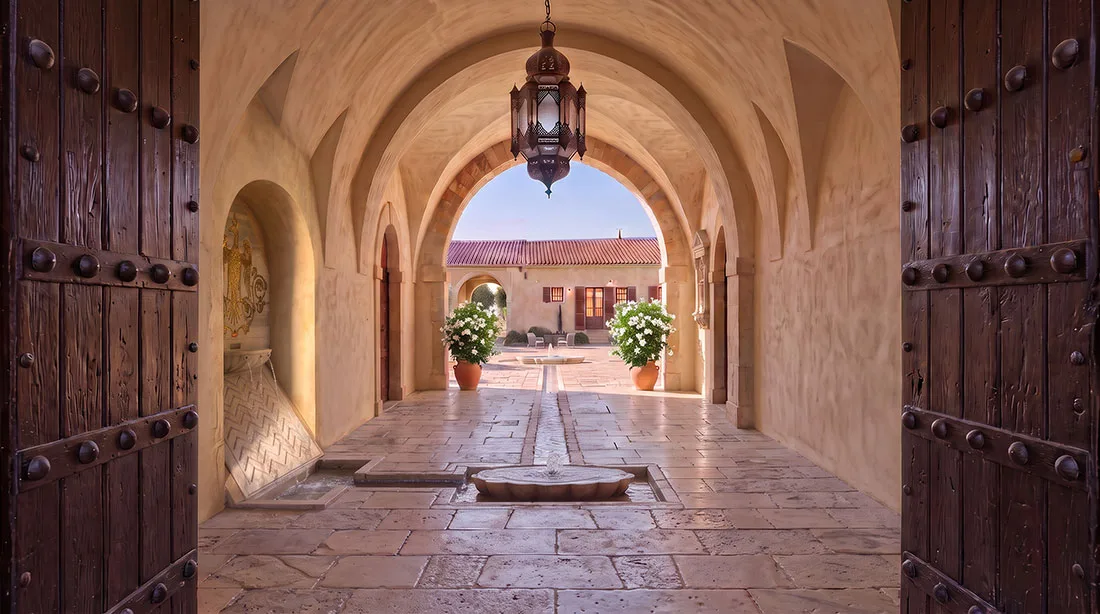
The Corral del Carbon
In Granada the Corral del Carbon, in Arabic al-Funduq al-Jadida and in Castilian Alhondiga Nueva, was built in the Nasrid period, at a date before 1336, the year of its first documentary mention. It belonged to the wives of the Nasrid sultans, and to this it owes a more monumental character than the other fondaci of the city.
The building is organised around an almost square courtyard of about sixteen metres eighty by fifteen sixty, surrounded by galleries on three levels carried on stone piers, with a basin at the centre. Outside, a projecting portal with a great pointed horseshoe arch within an alfiz, carved plasterwork and a muqarnas vault that keeps traces of polychromy; above the alfiz runs an epigraphic band in Kufic. The courtyard, by contrast, is plain and undecorated: the magnificence is at the entrance, the function inside.
Built as a warehouse for goods and lodging for passing merchants, the fondaco passed to the Crown after 1492, was sold at auction in 1531 and served as a corral de comedias until 1593; in the seventeenth century it became a tenement with a coal store on the ground floor, which earned it the name by which it is known today.
Declared a monument in 1918 and acquired by the State in 1933, it was restored by Leopoldo Torres Balbas, the same scholar who in 1946 wrote the reference study on it. Today it is public, free to enter, and houses the seat of the Fundacion Publica Andaluza El legado andalusi: the only Andalusian fondaco to have come down to us whole has become the home of the institution that studies and makes known its civilisation.
A precedent of reuse, not only of form
For a project that wants to put a fondaco back into use, that fact is worth more than the architectural description. The building has been put back to work rather than preserved as a relic, and the work assigned to it has to do with the same civilisation that built it.
Among the institutions of Granada concerned with this matter there is also the Fundacion Euroarabe de Altos Estudios, established in 1995 in the wake of a 1984 resolution of the European Parliament, whose board brings together the Spanish ministry for universities, the Junta de Andalucia and the University of Granada, and which alongside postgraduate training runs workshops on the arts of North Africa, among them ornamental yeseria.
The alhondigas were ordinary
That the type was widespread we know from documents more than from stones. The thirteenth-century partition records allow the fanadiq of Valencia, Murcia and Seville to be counted; at Denia excavation has identified at least seven fondaci of square or rectangular plan, and in Valencia a Muslim alhondiga has been excavated in calle Corretgeria. Historians distinguish the fondaco, granted by the Muslim authorities to the Christian merchant communities, from the alhondiga, an institution with storage and tax-collecting functions.
The word stayed with the buildings: alhondiga in Castile, fondech and alfondec in the Catalan and Aragonese lands. The Cid’s donation to the cathedral of Valencia in 1101 already lists alfondicis among its assets, and streets and squares in Cordoba, Malaga and Seville still bear the name.
The second half of the lesson
What happened afterwards is the part that interests this project as much as the first. The functions came apart: lodging passed to the hostals, grain and customs to the almodi or the public alhondiga. Some alfondecs remained in royal hands, and in Valencia in the fourteenth century one of them served to lodge Muslim muleteers and merchants, and to keep them apart. The name went on and the discipline changed.
It is the same drift as the Fondaco dei Turchi, reached by another road and two centuries earlier, and this is why the safeguards in our statutes are a demonstrated necessity rather than a declared intention.