THE WORKSHOP
The passage to master
The ṣāniʿ becomes muʿallim when the master who trained him judges him capable of it, and on this the house adopts the rules of the guilds of Fez.
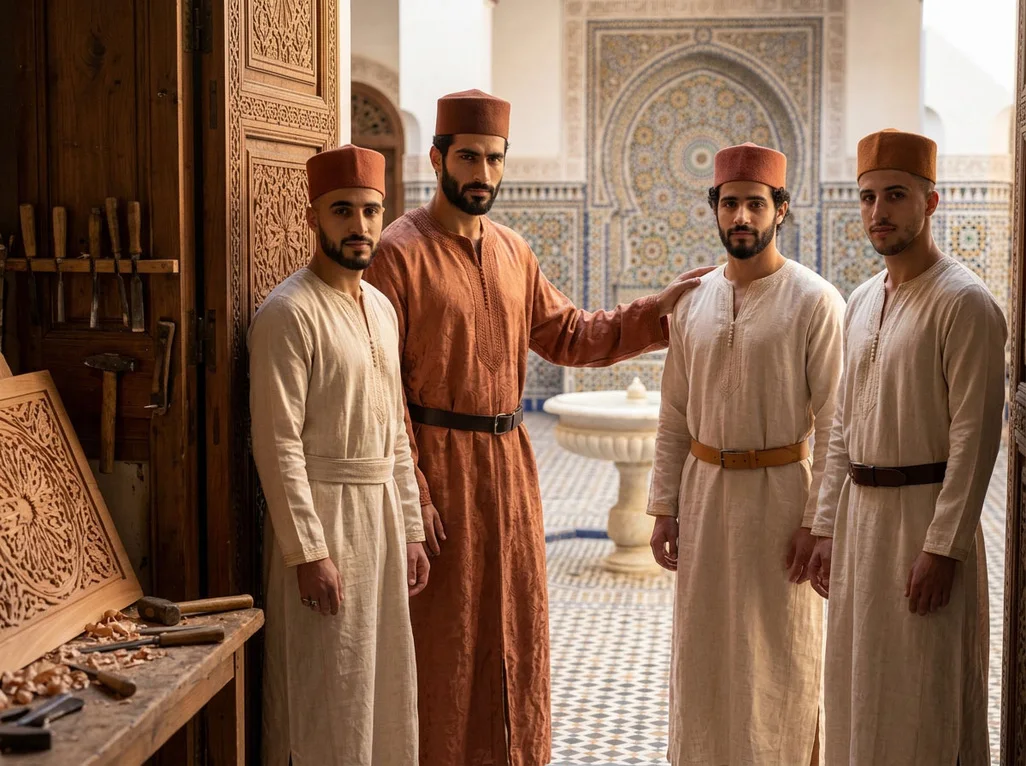
The ma’allim at the bench with three rifāq. Studio rendering.
Who decides
The master of the workshop decides, and he decides on the skill of the ṣāniʿ, because the only thing that can be judged with any exactness is the work, and the only one who sees it every day is the one who directs it. The majlis does not decide: it governs the house — the shifts, the table, the rules, the admission of new members — and its competence in the workshop stops at the conditions of work; putting a technical qualification to an assembly vote would turn it into a matter of internal relations, which is exactly what a school of the crafts must keep away from the bench.
There is, consequently, no set term. There is no number of years that ripens the title, and time spent in the house produces no advancement by itself: whoever acquires the hand sooner passes sooner, whoever does not acquire it remains ṣāniʿ for as long as it takes, and may not pass at all. In the guilds of Fez the length varies by craft and by man, and is fixed by no regulation the house has been able to verify: anyone wanting a number of years to put in a contract would not find it there, and the house does not invent one.
On what
The test is that of the guilds: a complete piece, made alone from beginning to end, with the materials, the tolerances and the times of a real commission. For saddlery it is a complete harness — leather tanned, cut and stitched with two needles, a shaped wooden tree, buckles, stirrups and spurs forged and finished — because that piece obliges whoever makes it to answer for the three materials together, which is after all why the workshop keeps them together.
The master does not touch it and does not correct it while it is being made. The piece is judged on how it holds under load, the precision of the assemblies, the finish in the places that are not seen, and its behaviour in use, which for a harness means some months in the riding ring and not an afternoon’s examination. A rejected piece is made again, and the house records neither the number of attempts nor the time taken.
What the title is worth
Inside the house the title carries precise things: one directs a bench, answers for the work that leaves it, receives one’s own ṣunnāʿ, and wears the rust-coloured garment with the dark leather belt tooled in gold. In the majlis it carries nothing, by express provision of the statutes: the workshop function pertains to the organisation of the work and to technical responsibility, and is not worth one vote more.
Outside the house the title, to be worth anything, needs a recognition the Funduq cannot give itself, and a qualification an institution issues to itself binds nobody. The road that will be tried, when there is someone to present, is that of the guild of Fez, which has issued that recognition for centuries and whose masters are the same who teach here: the terms have to be negotiated and have not yet been put. Until it exists, the title is worth what it is inside the house and among the workshops that know it, and this site attributes nothing more to it.
A NECESSARY CLARIFICATION
The title of ma’allim issued by the house has no legal value and is not equivalent to any Italian or European professional qualification. Anyone who needs a title recognised by the State obtains it where it is obtained, and the house neither replaces it nor anticipates it.
Where the master goes
The title does not bind him to the house that gave it. A master trained in Ragusa may stay there and direct a bench when the workshops multiply, open a workshop of his own, or be called by another house of the network that needs his craft; and the Sicilian house, in the same way, may call in from outside a master it does not have. If one day there were a fondaco in Granada, it could ask Ragusa for a master of saddlery and send Ragusa its masters of plaster and muqarnas, which this house does not have and which that city has known for seven centuries. The internal market the page on the network speaks of is made of this too: not only pieces and materials passing from one house to another, but men who go where their craft is needed.
This needs saying because it resolves a difficulty that would otherwise remain. The house in Fez is the source of the masters, and will be able to receive within its walls, as a guest, a master trained here; but not all those trained in Ragusa will be able to settle in the medina, by origin or by circumstance, and the house makes Fez nobody’s compulsory destination. In the opposite direction, whoever has come from Fez and, as a master, wished to stay in Europe meets the limits that the laws on residence set and that the house cannot remove. In both cases the horizon of the ṣāniʿ become master is the network of houses, not a single city, and the first commitment the houses would take towards one another is to place him where his craft and his circumstances allow.
The handing over
The handing over of the belt and the garment takes place at table, in front of the whole house, and is done by the master who judged the piece. No formulas are pronounced, no oath is sworn and one enters into nothing: what changes the next day is the bench one directs and the work one answers for. The belt is made by the house’s saddlery with the same leather and the same hot tooling as the commissions, or is ordered from the craftsmen of Fez until the house knows how to make it, so that the mark of the master is itself a master’s piece.

The belt of the ma’allim. Studio rendering.
What there is not
Between ṣāniʿ and muʿallim no rank intervenes. There are no intermediate levels, no colours for years of seniority and no honorary titles, and the nā’ib, the master’s deputy in the workshop, is an operational function assigned and revoked according to the work, without constituting a step towards the title.
The house knows no degrees of brotherhood, no initiations and no rites of passage of any other kind: what this page describes is a craft qualification, it is decided at the bench on the piece, and the only distinctions that follow from it are those described above: the direction of a bench, responsibility for the work that leaves it, and the garment.
Saddlery·Dress and outfit·The government of the house·Glossary