WATER
Water
In Andalusian hydraulic culture every device has a name and a function, and the two coincide with a precision that ornament would not explain.
The acequia distributes water by regulated turns, the alberca stores it in the garden and on the farm, the aljibe is the public cistern, often built against the mosque, the qanat captures it in a gently sloping gallery with intermediate shafts, the noria lifts it. The acequias of the gardens, observes Carmen Trillo San Jose, served not only to irrigate but «to cool the surroundings and to create a relaxed atmosphere, with sounds and scents of their own».
The lexicon has stayed in Sicily
Sicilian still keeps to this day the hydraulic and agrarian lexicon of the Islamic period: gebbia, from the Arabic jabiya, the collecting tank; saia, from saqiya, the walled channel; senia, from saniya, the noria; margio, from marj, the wet ground. Other terms, such as catusu for the pipe and dammusu for the vault, reach Sicilian through Arabic but go back to a Greek base.
The circumstance has a significance beyond erudition: the same works, with the same names, are still in use in the countryside of the island. A gebbia to be recovered on the property and an Andalusian alberca are the same object, and the mason who replasters it in lime does not need to be told what it is for.
The two devices in the courtyard
The basin flush with the paving
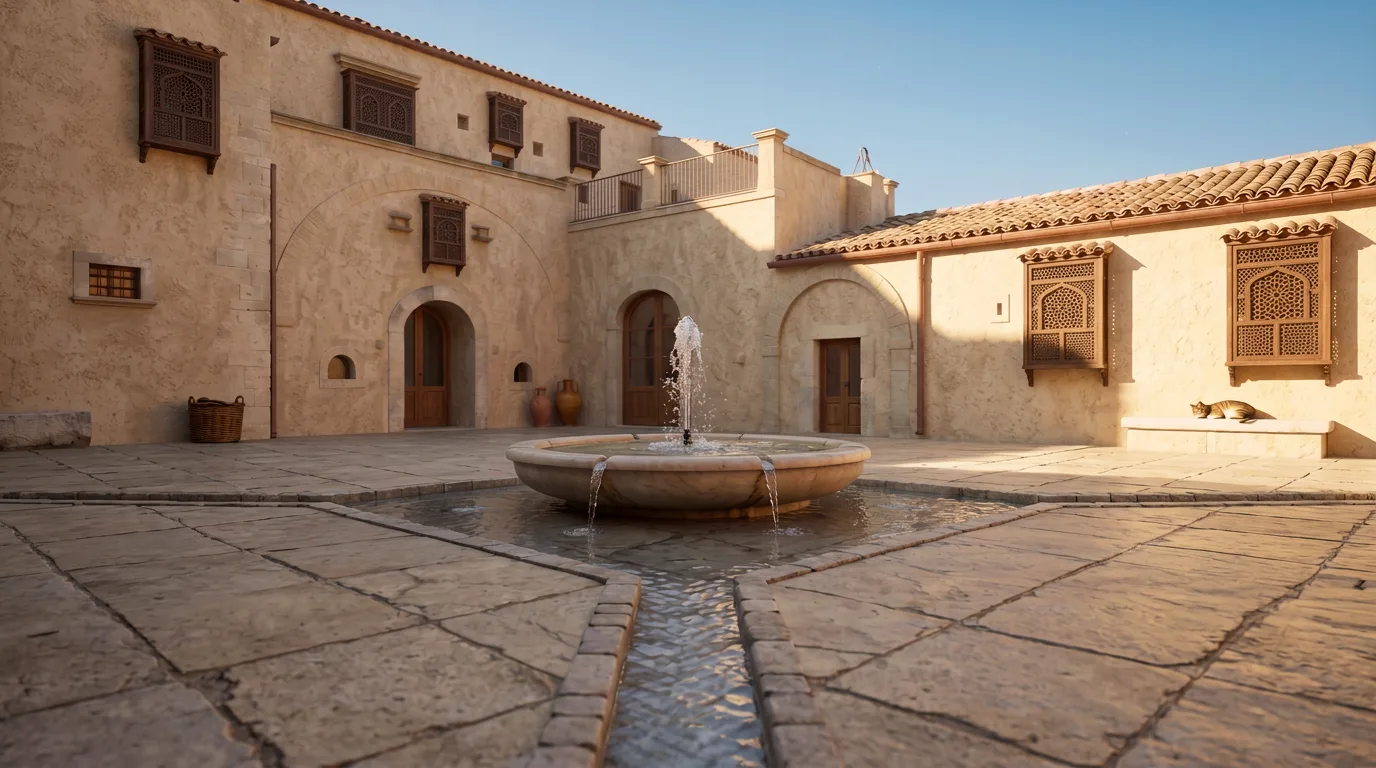
At the centre of the courtyard, flush with the paving. It is the fisqiya of the Arab-Andalusian houses, a basin at ground level designed to expose to the air the largest possible surface of water. The most accomplished expression of this principle is found in the Patio de los Leones and the Patio de la Acequia of the Alhambra, two courtyards where water laid flush cools the air before reflecting the sky.
The salsabil
The salsabil is an inclined slab, often rippled, down which water runs in a thin sheet: the form serves to maximise the surface exposed to the air, and with it evaporation, the oxygenation of the water and the sound that covers voices. In the design it is set against the wall of the garden and not at the centre of the courtyard, which keeps its own basin.
A Sicilian example is still in working order. In the Sala della Fontana of the Palazzo della Zisa in Palermo, built between 1165 and the years immediately following, water slides down an inclined marble slab decorated with chevrons and continues in a floor channel to two basins. The building is provided with ventilation shafts and opposed openings that ensured the summer exchange of air.
Collection, which comes before ornament
Neither device makes sense without a reserve that feeds them without consuming well water. The design provides for three hundred cubic metres of underground cisterns beneath the courtyard, whose excavation precedes the restoration of the wings and is subject to prior archaeological verification, the recovery of the existing tanks with remaking of the internal plasters and filtration, and the first-flush diverter, which discards the rain that carries the dust of the roofs.
The plumbing is a dual circuit, with rainwater and drinking water kept separate. Waste water is treated by constructed wetlands sized for forty population equivalents, there being no public sewer.
Water sung
In Andalusian poetry water is never a mere technical element, and it is treated with the same attention one would give a face.
وَالرَّوْضُ عَنْ مَائِهِ الفِضِّيِّ مُبْتَسِمٌ • كَمَا شَقَقْتَ عَنِ اللَّبَّاتِ أَطْوَاقَا
Wa-r-rawḍu ʿan māʾihi l-fiḍḍiyyi mubtasimun / kamā shaqaqta ʿani l-labbāti aṭwāqā
«And the garden smiles above its silver water, as when necklaces are parted over the breast.»
Ibn Zaydun (Cordoba, 1003-1071), from the qasida of al-Zahra’. Reading al-labbat, that of the anthologies.
NOTE ON SOURCES
The climatic functions of water in Andalusian architecture are asserted by the historical literature in qualitative terms. Measurements of temperature reduction obtained from basins or sheets of water are not published by any institutional source, and this site reports none.