COMMON LIFE
Dar al-Asl
The house of origin, inside Al-Munya: it lodges without charge the guests the house receives, and the costs fall on the company Al-Munya. Neither apprentices on trial, who sleep in the common dormitories, nor the members of An-Nudama, who are paying guests of Dar al-Diyafa, lodge here.
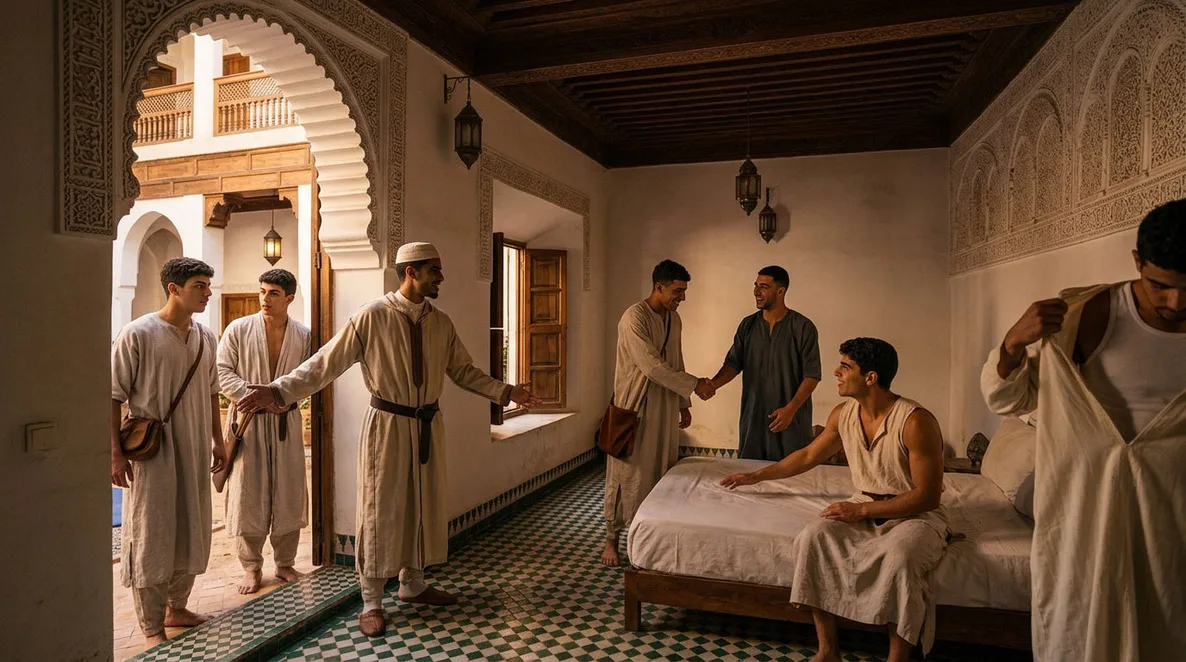
Whoever applies lodges in the common dormitories, with the same hours, the same work, the same table and the same outfit supplied by the house. At Dār al-Aṣl stay instead the guests the house receives without asking anything in return. No payment is due, and no payment — from whomever it comes — entitles anyone to the stay, determines its length or affects the outcome of the application.
Three kinds of stay, and what distinguishes them
What decides is the reason one comes, rather than the length of the stay or the origin, and on that depends where one sleeps as well.
- 1. The trial, at-tajriba. Two to four weeks, paid, on the building site or in the workshop, for those who want to know the life of the house because they intend to stay in it. One sleeps in the common dormitories. At the end, either a fixed-term apprenticeship contract opens, or the path ends.
- 2. The fixed-term stay, iqāma muwaqqata. Two weeks to three months, for those who want to know the house without putting themselves forward as members. Nothing is paid: hospitality is free, as the Mediterranean tradition wants and the Islamic one prescribes. It is granted on application, by written decision with fixed dates, may be renewed once and does not convert into admission.
- 3. Dar al-Diyafa, the guesthouse. For those who come not to know the house but to spend a few days in a beautiful place. One pays a rate, and stays in Dar al-Diyafa, the guesthouse inside Al-Munya: neither the hours, nor the shifts, nor the common table. Any request may be refused.
The distinction needs no policing, because it applies itself: whoever comes to rest does not choose a door that entails workshop hours and service shifts.
Open to anyone
The fixed-term stay is open to anyone, whatever their origin, language or culture: even to a European with no tie to that culture. Whoever enters by that door wears the same outfit, sits at the same table, does the same shifts and pays nothing.
It is the simplest and most rewarding way of knowing from the inside a civilisation of work that in Europe is almost unknown. Reading does not teach it; standing at a bench beside someone who practises it does.
Not to be confused. Al-Munya is the body. Inside: Dar al-Asl, where the guests of the house lodge without charge, and Dar al-Diyafa, where the nudamāʾ and their guests lodge against payment. Apprentices on trial sleep in the House’s dormitories. A stay at Dar al-Diyafa in no case entitles anyone to admission or to access to common life.